

Top
Author
Published
12 Jan 2026Form Number
LP2350PDF size
11 pages, 781 KBSubscribed to LP2350.
Thank you for your feedback.
Abstract
Multimodal Retrieval-Augmented Generation (RAG) extends traditional text-only pipelines by enabling LLMs to reason over both visual and textual content. As Vision-Language Models (VLMs) become central to document analysis, enterprise search, compliance review, and agentic copilots, the ability to run multimodal inference efficiently without relying exclusively on GPUs, which has become increasingly important.
In this paper, our experiments reveal that OpenVINO-optimized INT8 and FP16 pipelines on Xeon deliver dramatic reductions in Time-to-First-Token (TTFT) and Time-per-Output-Token (TPOT) compared with native FP16 execution, often coming close to GPU performance, especially for long-form multimodal outputs. For both vision and language stages, OpenVINO INT8 delivers 4× to 10× faster latency than stock FP16 on CPU. These results demonstrate that CPU-first multimodal RAG is now practical, cost-efficient, and scalable for enterprise use cases.
This paper is written for AI system architects, enterprise ML engineers, product teams building AI copilots, and infrastructure decision makers seeking to deploy multimodal RAG at scale. Readers will gain an understanding of practical performance expectations, model behavior across precisions, and how Intel technologies can support GPU-like multimodal inference without the operational overhead of accelerators.
Introduction
As Retrieval-Augmented Generation (RAG) evolves, the integration of multimodal inputs such as images, text, tables and even voice mark a critical shift in real-world AI applications. Traditional RAG systems focus primarily on text-based retrieval and generation. In contrast, Multimodal RAG incorporates visual and textual understanding into a unified pipeline, enabling more contextually rich and semantically complete reasoning.
This study explores the performance of Multimodal RAG across different hardware and optimization configurations, emphasizing how Intel Xeon 6 processors paired with OpenVINO optimizations can achieve GPU-like performance in visual-language tasks. We evaluate the performance of two representative models, Phi-3.5-vision-instruct (4B) and Mistral-7B-Instruct-v0.1, across several backend configurations on Intel Xeon 6787P, including FP16 precision, OpenVINO FP16 precision, and OpenVINO INT8 precision.
Other papers in this series:
This workflow below illustrates how OpenVINO enables an end-to-end path from model development to optimized deployment across heterogeneous Intel architectures. By supporting direct model conversion, low-precision optimization, and a unified runtime, OpenVINO allows vision and language models to be efficiently deployed on Xeon CPUs and other Intel platforms without changing application logic.
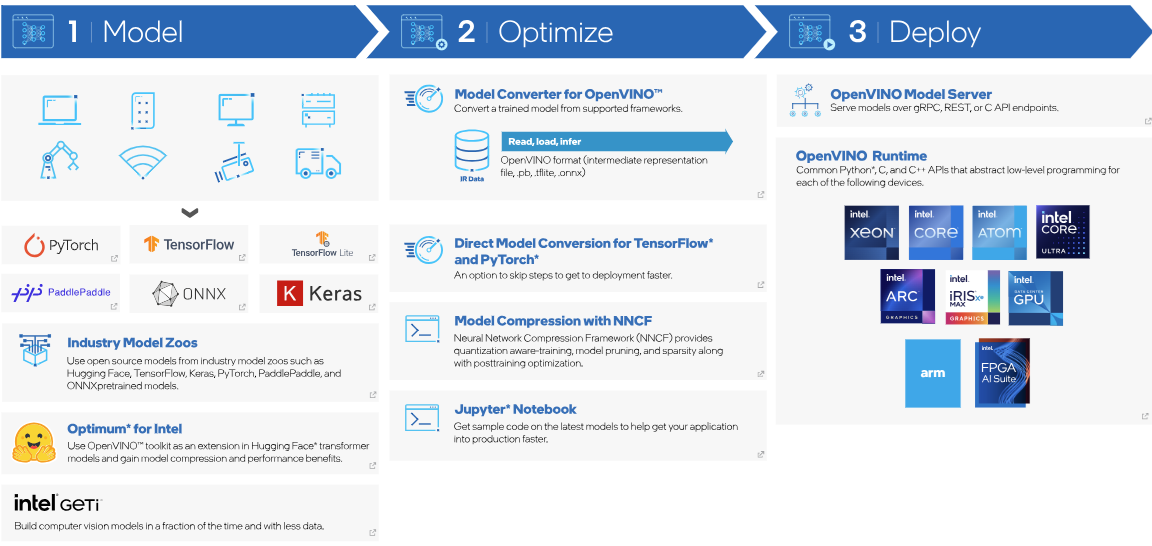
Figure 1. OpenVINO Summary Information
The figure below presents the multimodal RAG pipeline employed in this study. In contrast to traditional text-only RAG, multimodal RAG incorporates both textual and visual inputs. Images are transformed into textual representations via metadata extraction, and captioning. And then embedded alongside native text into a unified vector space. User queries are encoded in the same space, enabling cross-modal retrieval. Retrieved content is then routed to either a standard LLM or a vision-language model, depending on its modality, to generate the final response.
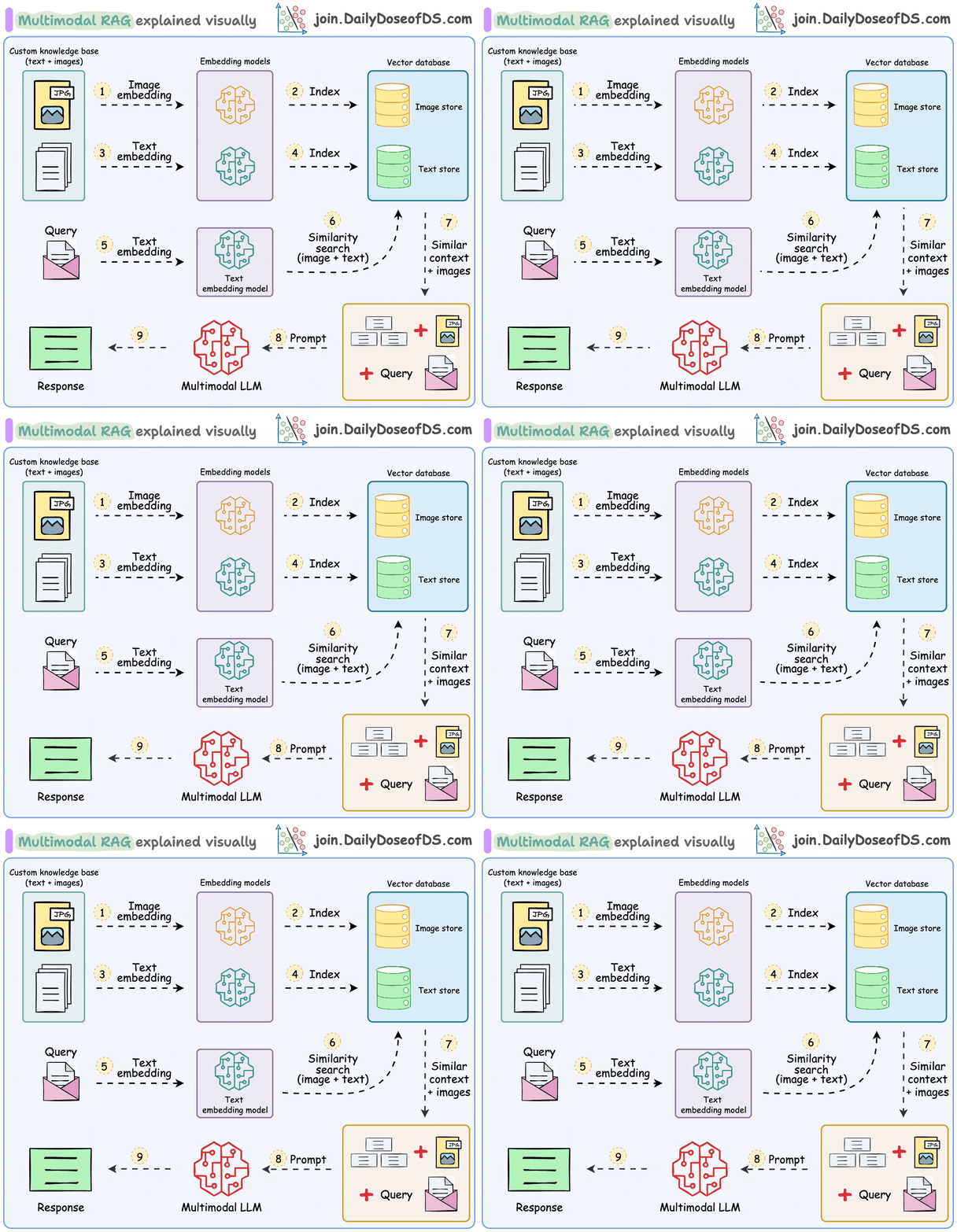
Figure 2. Diagram of Multimodal RAG (from DailyDoseofDS.com; used with permission)
Evaluation Metrics & Model Selection
This section evaluates multimodal RAG performance using latency-focused metrics that capture end-user responsiveness. We will cover Time-to-First-Token (TTFT) and Time-per-Output-Token (TPOT) which serve as the primary measures of inference efficiency. For model selection, we pair Phi-3.5-vision-instruct (4B) for visual understanding with Mistral-7B-Instruct-v0.1 for text generation, representing a typical multimodal RAG workflow. These choices enable controlled and comparable assessment across CPU, OpenVINO-optimized, and GPU baseline configurations.
We are focusing on the performance metrics that matter for production RAG:
- TTFT (Time to First Token) (s): interactive latency; lower is better. It captures the delay before the system acknowledges a user request and begins producing the first output.
- TPOT(Time Per Output Token) (ms): average time to generate each individual output token after first token, also known as inter-token latency; lower is better. It dominates the total response time for long-form outputs, where hundreds of tokens may be generated. Therefore, inter-token latency becomes the key.
We selected the following models:
- Vision-Language Model: Phi-3.5-vision-instruct (4B parameters), capable of visual grounding and multimodal reasoning.
- Language Model (LLM): Mistral-7B-instruct-v0.1, optimized for high-quality text generation and instruction following.
The models are described in the following links:
- Microsoft/Phi-3.5-vision-instruct: https://huggingface.co/microsoft/Phi-3.5-vision-instruct
- Mistralai/Mistral-7B-Instruct-v0.1: https://huggingface.co/mistralai/Mistral-7B-Instruct-v0.1
All experiments were performed on a controlled evaluation environment comparing native FP16, OpenVINO FP16, and OpenVINO INT8 inference on Intel Xeon 6787P. This setup isolates the impact of backend optimization and precision reduction on multimodal RAG latency.
The following table summarizes the hardware platforms, inference backends, and precision modes evaluated in this study, serving as the basis for all performance comparisons reported in the following sections.
Performance Results & Analysis
This section presents the measured latency characteristics of the multimodal RAG pipeline, focusing on Time-to-First-Token (TTFT) and Time-per-Output-Token (TPOT) across all tested backends. Results are organized by workload and platform, highlighting how OpenVINO optimizations on 6th-Gen Intel Xeon (6787P) substantially reduce inference latency and enable competitive performance relative to GPU baselines. These findings provide practical guidance for meeting SLA targets and planning multimodal RAG deployment capacity.
Time to First Token (TTFT)
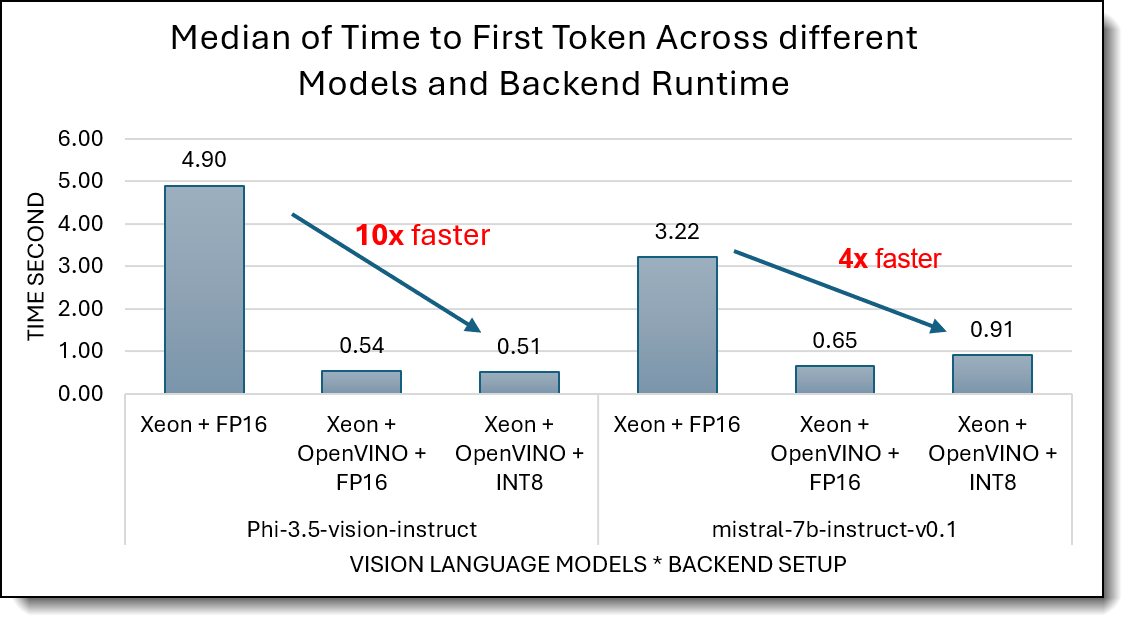
The chart below shows that OpenVINO effectively minimizes startup latency through optimized precision compression and system runtime.
- OpenVINO dramatically reduces TTFT on Xeon 6787P.
- Native FP16 shows higher startup latency (4.9 s for Phi-3.5-vision-instruct, 3.2 s for Mistral-7B).
- With OpenVINO FP16 and INT8, TTFT drops to about 0.5 s, an near 10× reduction, largely due to graph compilation, operator fusion, and optimized memory scheduling.
- OpenVINO brings CPU TTFT close to GPU-class behavior.
- While the H100 FP16 baseline achieves ~0.08 s, the 0.5 s TTFT on Xeon with OpenVINO is within practical bounds for interactive multimodal use and represents a major narrowing of the CPU - GPU gap.
Time per Output Token (TPOT)
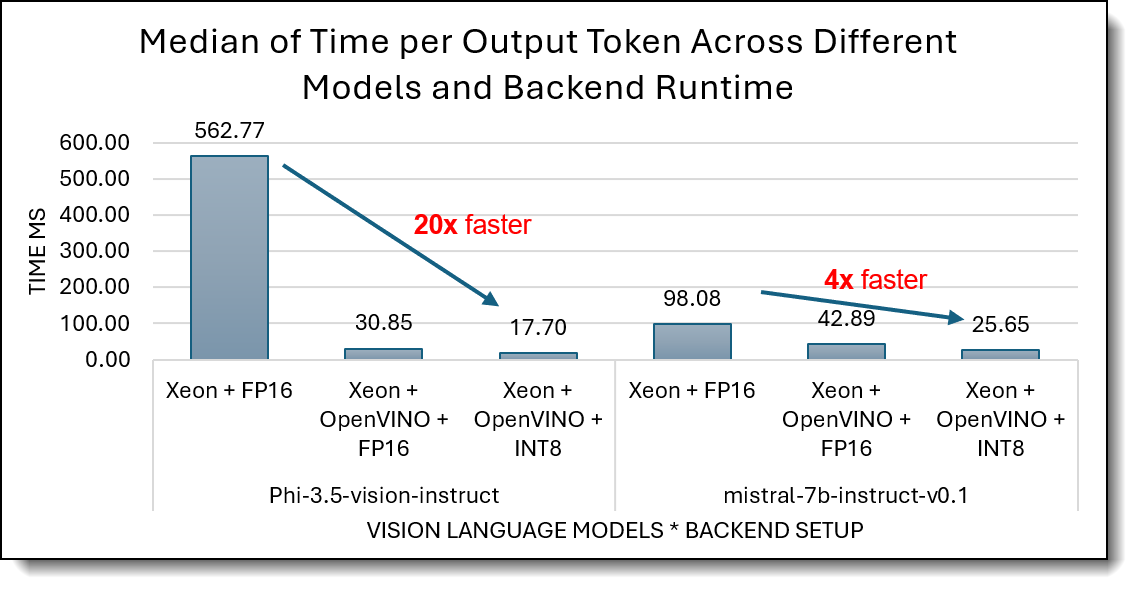
The chart below shows how Intel Xeon 6787P CPUs and OpenVINO successfully reduce the Time-per-Output-Token (TPOT) to a performance level that meets the SLA standards.
- For Phi-3.5-vision-instruct, native FP16 produces slow generation (about b560 ms/token), while OpenVINO FP16 (31 ms/token) and OpenVINO INT8 (18 ms/token) reduce latency by 18× and 30×, respectively. These improvements stem from optimized kernel execution, reduced precision compute, and efficient operator fusion.
- For Mistral-7B-Instruct, OpenVINO INT8 reaches about 26 ms/token, comfortably exceeding real-time interaction thresholds; for reference, human reading speed is 90 ms/token (≈6 words/sec), meaning the model streams tokens faster than users can consume them.
Generation Latency for Language and Vision Language Model
This section examines generation latency for vision-language workloads as output length increases, focusing on how backend optimization and precision affect end-to-end response time. By evaluating multiple output lengths, we capture the cumulative impact of per-token latency on long-form multimodal generation, which is critical for document understanding, visual reasoning, and agent-driven workflows.
The data and figures below show that generation latency grows linearly with output length for both Phi-3.5-vision-4B and Mistral-7B models, making per-token efficiency the dominant factor for long responses. Across all output sizes, OpenVINO significantly reduces total generation time compared to native FP16 execution, with INT8 consistently delivering the lowest latency. For Phi-3.5-vision-4B, OpenVINO INT8 achieves up to a 97% reduction in total generation latency at long output lengths, while Mistral-7B shows a 74% reduction, demonstrating that low-precision inference is especially effective in controlling latency growth as output length scales.
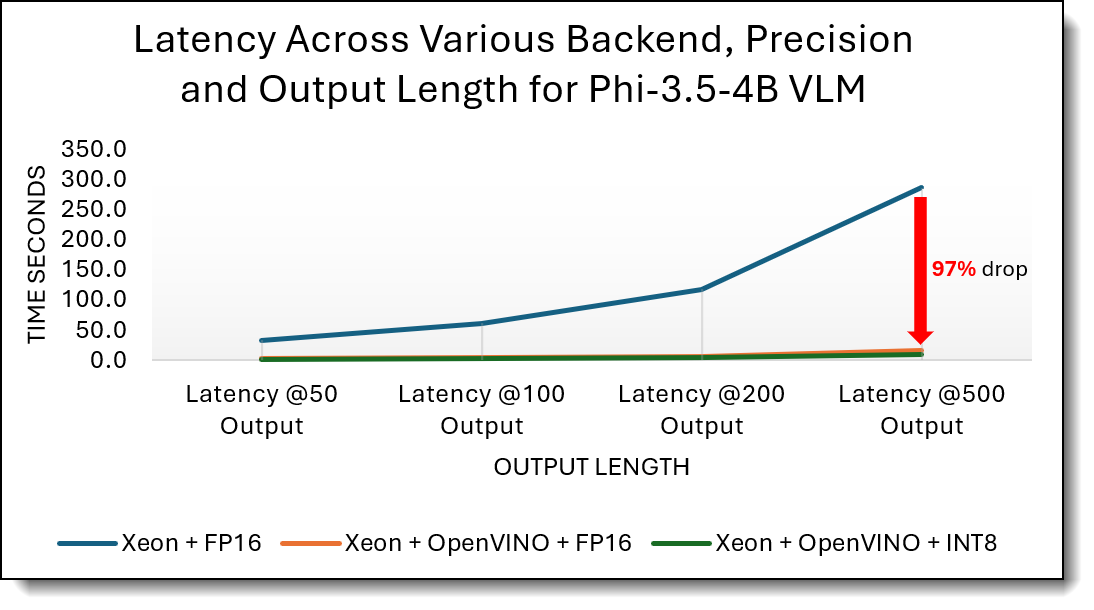
Figure 5. Generation Latency per output length - Phi-3.5-vision-instruct (lower is better)
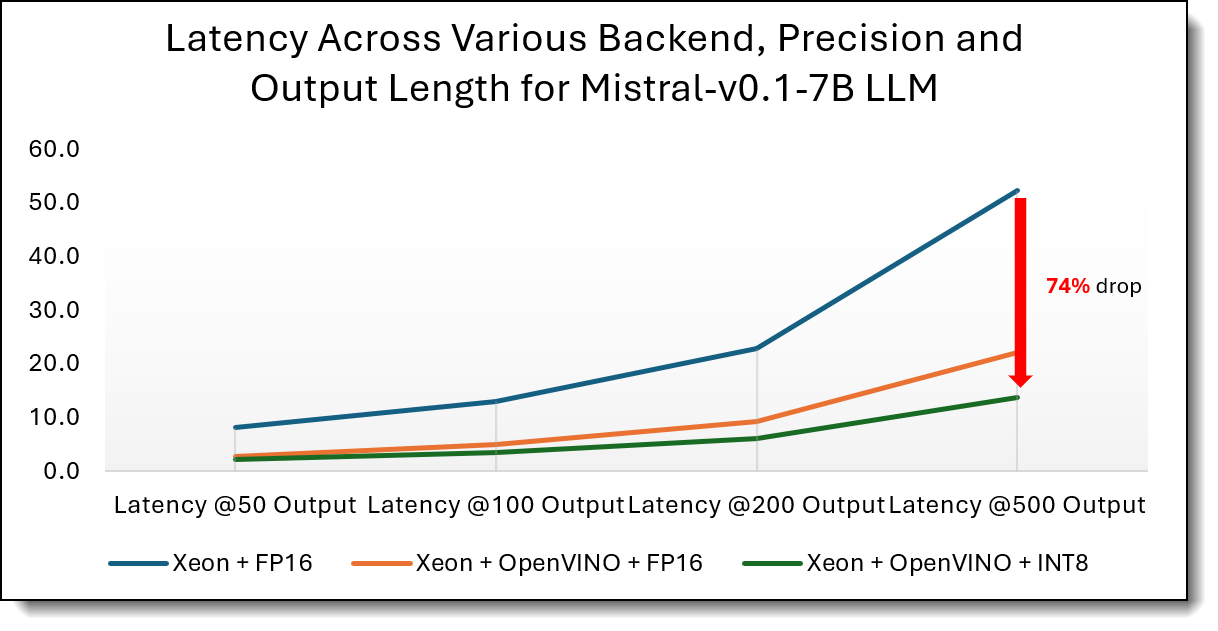
Figure 6. Generation Latency per output length - Mistral-7B-instruct (lower is better)
Conclusion and Business Impact
This study demonstrates that OpenVINO substantially accelerates both latency and generation speed for multimodal RAG workloads on Intel Xeon 6787P. Across vision-language and text-only models, OpenVINO optimizations reduce Time-to-First-Token (TTFT) and Time-per-Output-Token (TPOT) by an order of magnitude compared to native CPU inference. These gains transform Xeon from a baseline CPU platform into a production-capable engine for interactive and long-form multimodal generation.
This section synthesizes the performance comparison and findings along with a visualization of multimodal RAG demo in real-world deployment.
Business Impact based on Real-Time SLA Targets
To assess production readiness, we evaluate OpenVINO-enabled serving against practical real-time SLA thresholds. We conducted benchmark on vLLM and with openVINO as backend and continuous batching for Language Model, and OpenVINO Model Server with continuous batching for Vision Language Models
The following summarizes the maximum sustainable concurrency on a single Intel Xeon 6787P system with OpenVINO while meeting real-time responsiveness targets:
- For the LLM experiments, we used vLLM with continuous batching and issued 200 prompts drawn from the ShareGPT_V3_unfiltered_cleaned_split.json dataset
- For the VLM experiments, we used OpenVINO Model Server (OVMS) with continuous batching and evaluated 200 prompts from lmarena-ai/vision-arena-bench-v0.1.
For each model size and precision mode (FP16, INT8), we increased concurrency until the P90 latency exceeded the SLA thresholds, and report the highest concurrency that still satisfies P90 TTFT ≤ 10 seconds and P90 TPOT ≤ 130 ms/token. Overall, the table provides a practical capacity-planning view of how precision and model size translate into supported concurrent users for both text-only and multimodal serving on Xeon.
Under practical real-time SLA targets (TTFT ≤ 10s, TPOT ≤ 130ms), OpenVINO with INT8 precision enables a single Xeon 6787P system to support dozens of simultaneous users for small-to-mid-sized language models and multiple concurrent multimodal sessions, without GPU acceleration. In concrete terms, one server can serve up to 44 concurrent users for 3B LLMs, 32 users for 8B LLMs, and 10 users for 3B vision-language models, translating into higher infrastructure utilization, lower per-user cost, and greater deployment flexibility for enterprise RAG and copilot workloads.
Multimodal Latency Demonstration
To complement quantitative benchmarks, we present a side-by-side latency demonstration comparing Intel Xeon 6787P with OpenVINO against plain CPU for multimodal generation. The OpenVINO-optimized Xeon system can deliver smooth, real-time token streaming with latency well below human consumption rates.
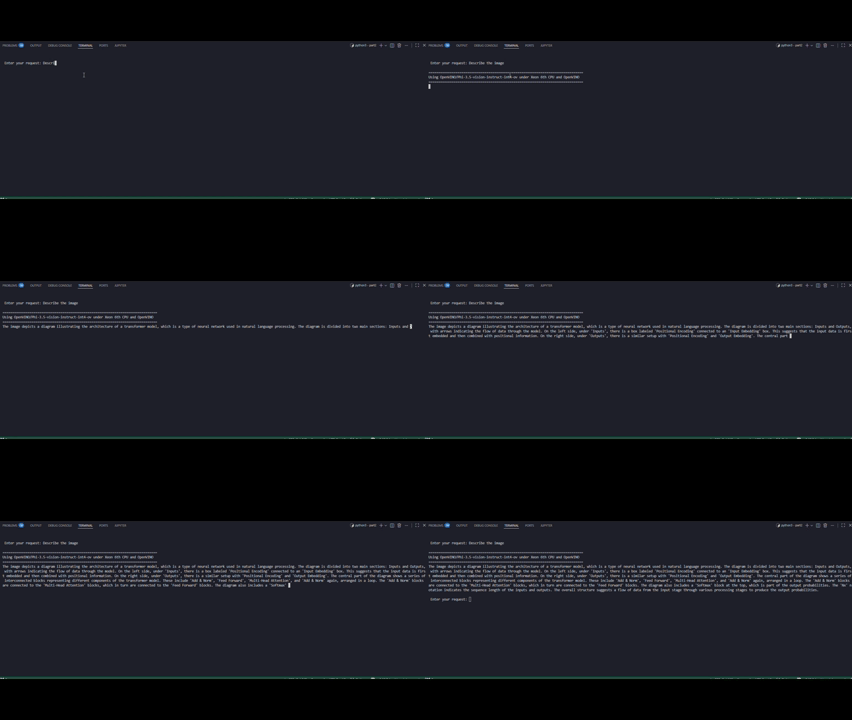
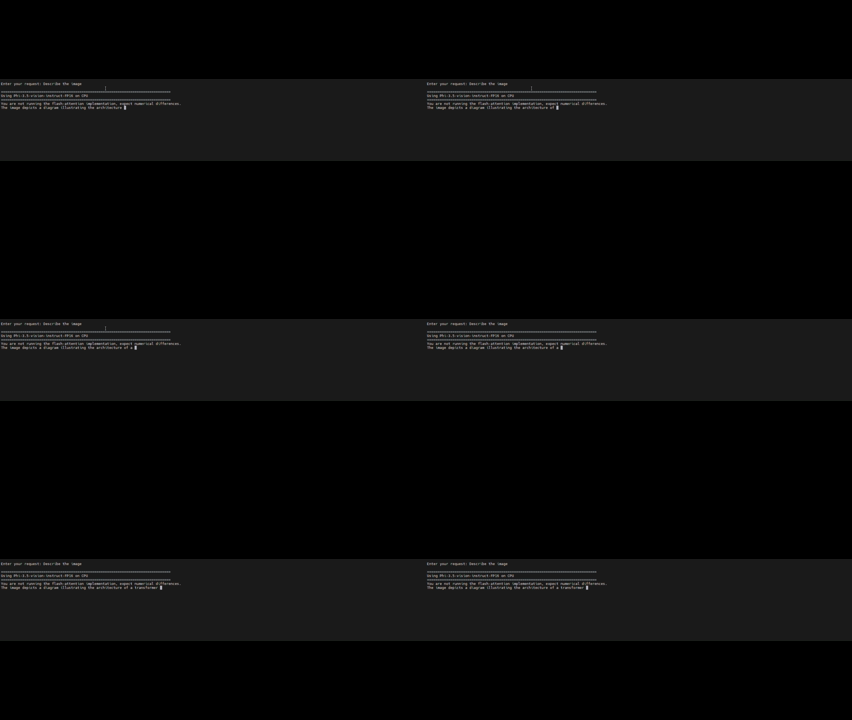
The following figure shows a side-by-side demonstration of multimodal response generation using OpenVINO INT8 (left) and without OpenVINO optimization (right).
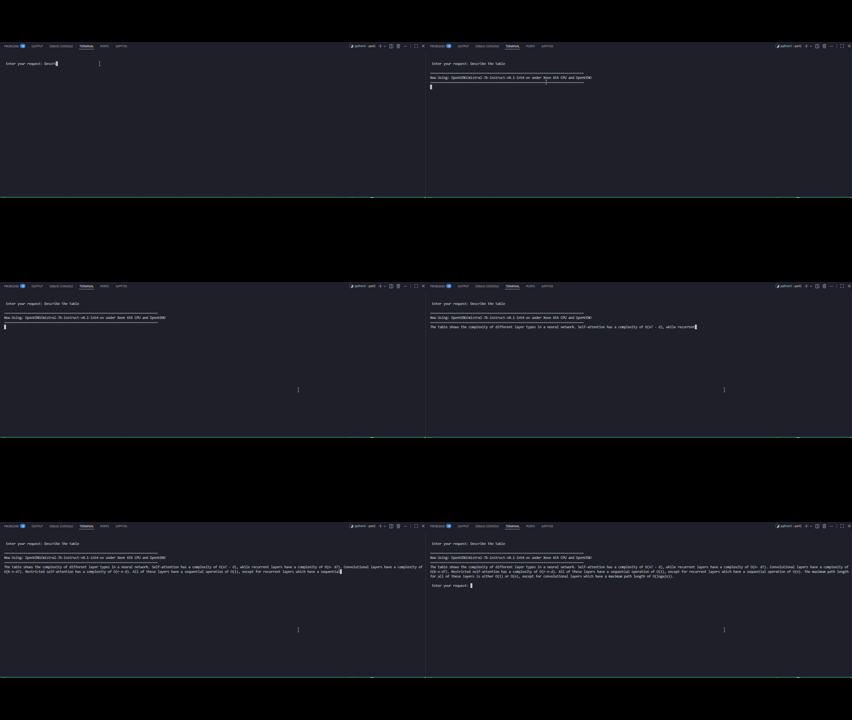
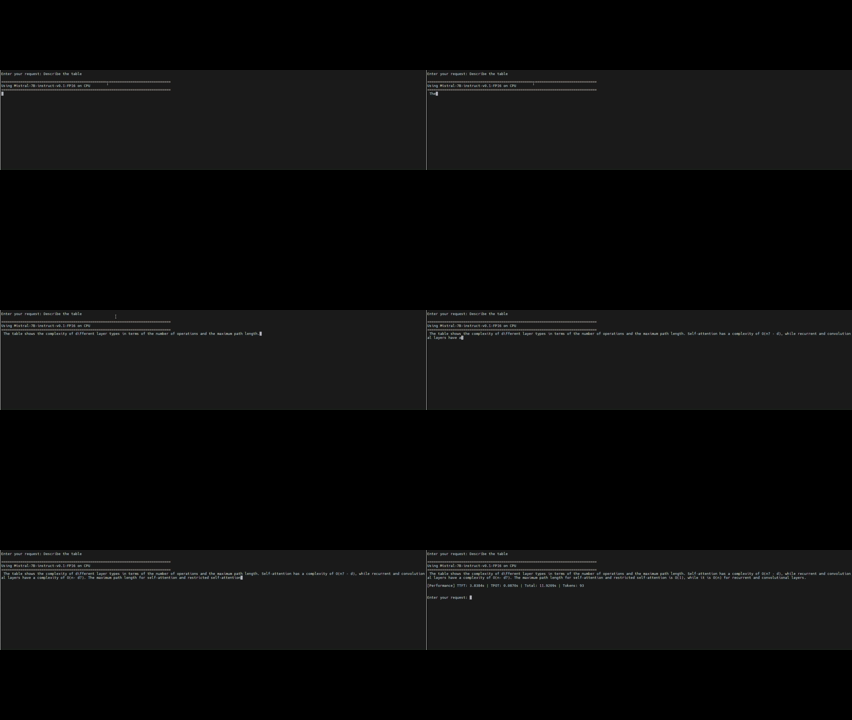
The demonstration clearly shows that OpenVINO is the decisive factor in enabling real-time multimodal generation on Xeon 6787P:
- Without OpenVINO (animations on the right), native FP16 execution exhibits noticeably slower token emission and higher end-to-end latency, resulting in delayed and uneven response streaming.
- In contrast, OpenVINO-optimized FP16 and INT8 inference (animations on the left) delivers immediate token generation and a steady, high-rate output stream, closely matching the quantitative improvements observed in TTFT and TPOT benchmarks.
These results reinforce that hardware alone is insufficient—it is the combination of Xeon architecture with OpenVINO’s graph optimization, kernel fusion, and low-precision execution that makes multimodal RAG practical and production-ready on CPU platforms.
Additional papers on RAG
This paper is Part 2 of 4 of a series of papers on Retrieval Augmented Generation.
The papers in the series are as follows:
- Part 1: Standard Retrieval-Augmented Generation: implement and benchmark a text-only RAG pipeline on Intel platforms, evaluate embedding and generation model combinations, and quantify retrieval latency, TTFT, TPOT, and throughput to establish CPU-first performance baselines from search to answer generation. Read the paper here: Standard Retrieval Augmented Generation on Intel: From Search to Answers
- Part 2: This paper
- Part 3: Multimodal RAG Architecture Trade-offs: systematically compare three multimodal RAG designs, text-mediated, hybrid, and multimodal embedding–based, analyzing indexing cost vs. query-time latency, retrieval accuracy vs. grounding fidelity, and scalability under SLA constraints to establish practical design guidelines for enterprise deployment. Read the paper here: End-to-End Latency Benchmarking for Three Multimodal RAG Architectures
- Part 4: Agentic Long-Context RAG: introduce planning and tool use with validation loops (self-check, re-query, re-rank), add long-context memory, and evaluate end-to-end task success, stability across multi-step trajectories, and cost–latency trade-offs. Coming soon.
System Configuration
The configuration of the server used in our testing is as follows:
- CPU: Intel Xeon 6787P processor, 86 cores / 172 threads @ 3.8 GHz
- GPU: None
- Memory: 16x 64 GB DDR5 @ 6400 GHz
- Cache: 336 MB
- OS: Ubuntu 22.04.5 LTS (Linux kernel 6.8.0-59-generic)
- Python: 3.12.3
- OpenVINO: 2025.4.0-20398
- Transformer: 4.45.0
Resources
This paper is Part 2 of 3 of a series of papers on Retrieval Augmented Generation.
Part 1: Standard Retrieval Augmented Generation on Intel: From Search to Answers
https://lenovopress.lenovo.com/lp2322-standard-retrieval-augmented-generation-on-intel-from-search-to-answers
For more information, see these resources:
- Lewis et al. “Retrieval-Augmented Generation for Knowledge-Intensive NLP.” arXiv:2005.11401
https://arxiv.org/abs/2005.11401 - MuRAG: Multimodal Retrieval-Augmented Generator for Open Question Answering over Images and Text
https://arxiv.org/abs/2210.02928 - OpenVINO Toolkit:
https://www.intel.com/content/www/us/en/developer/tools/openvino-toolkit/overview.html - OpenVINO GenAI Model:
https://openvinotoolkit.github.io/openvino.genai/docs/use-cases/image-processing/ - Huggingface OpenVINO Toolkit:
https://huggingface.co/OpenVINO/collections - Intel Advanced Matrix Extensions (Intel AMX):
https://www.intel.com/content/www/us/en/products/docs/accelerator-engines/what-is-intel-amx.html - Intel Xeon 6787P (Intel Xeon 6 / Granite Rapids) product page:
https://www.intel.com/content/www/us/en/products/sku/241844/intel-xeon-6787p-processor-336m-cache-2-00-ghz/specifications.html - OpenVINO Model Server
https://docs.openvino.ai/2025/model-server/ovms_what_is_openvino_model_server.html - UX response-time thresholds (≈0.1 s instant / ≈1 s flow / ≈10 s attention): Nielsen Norman Group
https://www.nngroup.com/articles/response-times-3-important-limits/ - Average adult silent reading speed (200–300 wpm):
https://en.wikipedia.org/wiki/Words_per_minute
Model cards:
- OpenVINO/Phi-3.5-vision-instruct-int8-ov
https://huggingface.co/OpenVINO/Phi-3.5-vision-instruct-int8-ov - OpenVINO/Phi-3.5-vision-instruct-fp16-ov
https://huggingface.co/OpenVINO/Phi-3.5-vision-instruct-fp16-ov - microsoft/Phi-3.5-vision-instruct
https://huggingface.co/microsoft/Phi-3.5-vision-instruct - OpenVINO/mistral-7b-instruct-v0.1-int8-ov
https://huggingface.co/OpenVINO/mistral-7b-instruct-v0.1-int8-ov - OpenVINO/mistral-7b-instruct-v0.1-fp16-ov
https://huggingface.co/OpenVINO/mistral-7b-instruct-v0.1-fp16-ov - mistralai/Mistral-7B-Instruct-v0.1
https://huggingface.co/mistralai/Mistral-7B-Instruct-v0.1
Author
Kelvin He is an AI Data Scientist at Lenovo. He is a seasoned AI and data science professional specializing in building machine learning frameworks and AI-driven solutions. Kelvin is experienced in leading end-to-end model development, with a focus on turning business challenges into data-driven strategies. He is passionate about AI benchmarks, optimization techniques, and LLM applications, enabling businesses to make informed technology decisions.
Trademarks
Lenovo and the Lenovo logo are trademarks or registered trademarks of Lenovo in the United States, other countries, or both. A current list of Lenovo trademarks is available on the Web at https://www.lenovo.com/us/en/legal/copytrade/.
The following terms are trademarks of Lenovo in the United States, other countries, or both:
Lenovo®
The following terms are trademarks of other companies:
Intel®, the Intel logo, OpenVINO®, and Xeon® are trademarks of Intel Corporation or its subsidiaries.
Linux® is the trademark of Linus Torvalds in the U.S. and other countries.
Microsoft® is a trademark of Microsoft Corporation in the United States, other countries, or both.
Other company, product, or service names may be trademarks or service marks of others.
Configure and Buy
Please select a locale
Full Change History
Course Detail
Employees Only Content
The content in this document with a is only visible to employees who are logged in. Logon using your Lenovo ITcode and password via Lenovo single-signon (SSO).
The author of the document has determined that this content is classified as Lenovo Internal and should not be normally be made available to people who are not employees or contractors. This includes partners, customers, and competitors. The reasons may vary and you should reach out to the authors of the document for clarification, if needed. Be cautious about sharing this content with others as it may contain sensitive information.
Any visitor to the Lenovo Press web site who is not logged on will not be able to see this employee-only content. This content is excluded from search engine indexes and will not appear in any search results.
For all users, including logged-in employees, this employee-only content does not appear in the PDF version of this document.
This functionality is cookie based. The web site will normally remember your login state between browser sessions, however, if you clear cookies at the end of a session or work in an Incognito/Private browser window, then you will need to log in each time.
If you have any questions about this feature of the Lenovo Press web, please email David Watts at dwatts@lenovo.com.


