

Top
Author
Published
30 Mar 2026Form Number
LP2412PDF size
10 pages, 506 KBSubscribed to LP2412.
Thank you for your feedback.
Abstract
This document provides essential pre-sales information to understand MongoDB on Lenovo ThinkAgile HX650 V4 and FX V4 systems integrated with Nutanix software, including the key features of the tested solution, infrastructure configuration, benchmark methodology, and observed performance characteristics. It is intended for technical specialists, sales specialists, sales engineers, IT architects, and other IT professionals who want to learn more about MongoDB on Lenovo ThinkAgile platforms with Nutanix software and consider its use in enterprise database solutions.
Introduction
A Modern Data Platform for Private Cloud, AI/ML, and Analytics
Today’s enterprise applications increasingly rely on dynamic, fast changing, and diverse data sources from customer profiles and product catalogs to clickstream events, IoT telemetry, application logs, and operational metrics. These workloads rarely fit neatly into rigid relational schemas. As a result, organizations are turning to document-based data models that align more naturally with the way modern applications evolve. MongoDB has emerged as a leading operational database platform for these scenarios because it enables agility, scalability, and simplicity across the full application lifecycle. MongoDB’s document data model is flexible, semi-structured or hierarchical data model to support rapid application development cycle without constant schema redesign and refactoring resulting faster time to market. MongoDB’s horizontal scalability across clusters, high availability with built in replication and resilience for mission critical workload makes ideal for ingest-heavy environments such as IoT platforms, streaming analytics, and large-scale operational systems. MongoDB as a vector database combines vector search with full text search to retrieve most relevant results to power AI applications and agentic systems with retrieval augmented generation (RAG).
Lenovo ThinkAgile HX V4 and FX V4 with Intel Xeon 6 Processors
The Lenovo ThinkAgile HX650 V4 and FX650 V4 are 2-socket, 2U systems and The Lenovo ThinkAgile HX630 V4 and FX630 V4 are 2-socket, 1U systems. These hyperconverged systems feature the 6th Generation Intel Xeon Scalable processors (formerly code named "Granite Rapids"). ThinkAgile HX V4 and FX V4 hyperconverged systems are designed for deploying industry-leading hyperconvergence software from Nutanix on Lenovo enterprise platforms. The Nutanix Cloud Platform (NCP) delivers cloud‑scale advantages to enterprise applications and databases by combining ThinkAgile HX V4 and FX V4 and public cloud infrastructure. It provides robust enterprise storage, integrated data protection, built‑in resilience, unified management, advanced analytics, and end‑to‑end security and consistent performance for mission‑critical workloads.
ThinkAgile FX offers a unique, industry first flexibility for software-defined approach to hyper convergence, leveraging the ability to move between hypervisors of your choice to deliver compute, storage and management in a tightly integrated software stack and future-proof your investment with seamless HCI software transitions.
Combining performance and flexibility, the ThinkAgile HX V4 and FX V4 Hyperconverged systems deliver fully validated and integrated Lenovo hardware and firmware, certified and preloaded with licensed Nutanix software. The systems offer a broad selection of processors, memory and drives, and offers high performance features that industries such as finance, healthcare and telco need. Outstanding reliability, availability, and serviceability (RAS) and high-efficiency design can improve your business environment and can help save operational costs.
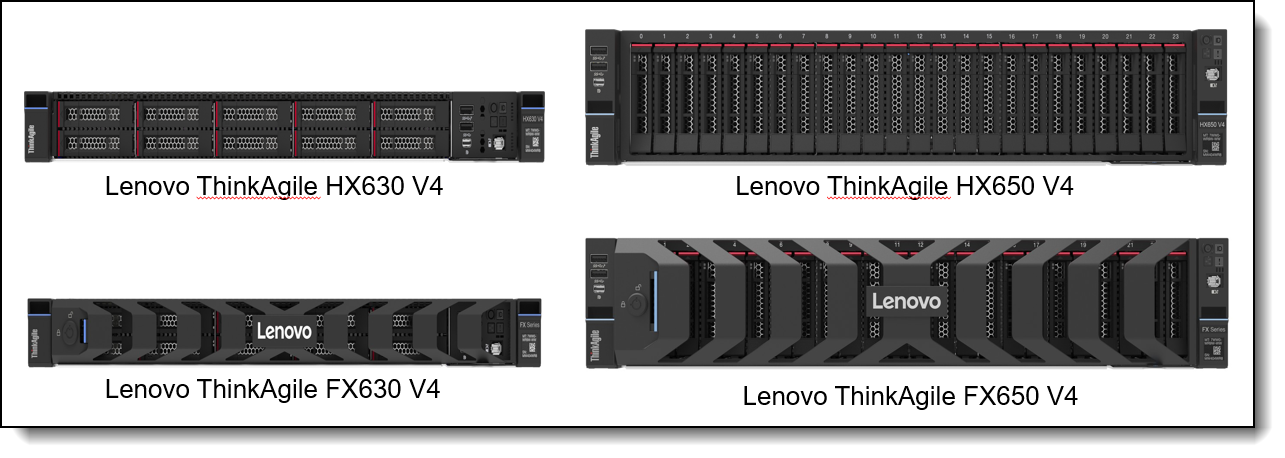
Figure 1. Lenovo ThinkAgile HX and FX V4 Systems
Lenovo ThinkAgile HX V4 and FX V4 Hyperconverged systems running Nutanix software provide a robust foundation for MongoDB by combining compute, storage, and virtualization in a unified hyperconverged platform. This architecture supports simplified operations, efficient scaling, and resilient infrastructure, while allowing MongoDB to take advantage of high core-count processors and large memory capacity for strong performance in insert-heavy and mixed read/write workloads.
MongoDB Features
Transactions, Analytics and Vector database
MongoDB’s combination of flexible modeling, distributed architecture, and AI-ready search and vector capabilities makes it a powerful choice for enterprises modernizing their private cloud and data platforms. MongoDB is a Document-based NoSQL database that uses BSON documents to map and store dynamic and semi-structured data which enables to build adaptable applications without rigid relational schemas.
MongoDB architecture consists of:
- mongod – primary database engine responsible for storage and querying
- mongos – a query router for sharded clusters, routing client requests to appropriate shards
- Config servers (CSRS) – store cluster metadata and sharding configuration
Replica Sets ensure high availability and fault tolerance by maintaining multiple copies of data across nodes. Primary node handles writes; secondary nodes replicate via the oplog and supports globally distributed deployments.
Sharding enables horizontal scaling across many machines for large datasets and high-throughput workloads by using shards (Replica set), partitioned data subsets.
MongoDB’s aggregation framework supports Time-series optimizations, complex transformations and real time analytics.
MongoDB Ops Manager: The "Command Center" for enterprise deployments. It automates backups, point-in-time recovery, and rolling upgrades.
MongoDB supports AI-native capabilities bringing full-text, semantic, and vector search to self managed and on prem deployment to build RAG (Retrieval Augmented Generation) systems directly where your data lives and eliminate external vector DBs and search engines, reducing complexity and latency.
MongoDB provides 8.2 provide significant performance improvement for unindexed queries and time series bulk inserts. Queryable Encryption enhances secure operations without compromising query expressiveness.
Nutanix Database Service (NDB) enables you to register, provision, clone, and administer all MongoDB databases on one or more Nutanix clusters and it supports single node and multiple node configurations. The MongoDB databases can be deployed manually without NDB and scaled as well.
YCSB overview
Yahoo Cloud Serving Benchmark (YCSB) is a benchmarking framework that is used to evaluate NoSQL and cloud-serving databases. It is designed to simulate application-access patterns and allows for a repeatable means of measuring latency and the throughput of a database under various load conditions.
There are two phases for the YCSB benchmarks:
- Load - the dataset used during testing is loaded into the database.
- Run - transactional workload (either read, update, insert or scan) defined by the mix of transactions is executed against the database. This makes it possible to test both the pure ingest of data as well as operational workloads randomly using a mixture of transaction types.
In this study, YCSB was used to evaluate MongoDB using only insert workloads and mixed read-write workloads while varying the size of the documents inserted into the database. By changing the size of the documents being added to the database and keeping the client-side concurrency the same, the benchmark demonstrates how the architecture of the database responds to different payload sizes and how throughput and latency react to different patterns of workloads.
Configurations
Hardware Configuration
The Nutanix cluster was built on four Lenovo ThinkAgile HX650 V4 systems. Each host was equipped with two Intel Xeon 6767P processors, with 64 cores per processor, for a total of 128 physical cores per host. Each host also included 1 TB of memory, NVMe-based local storage, and 10/25GbE network connectivity. This provided a dense computing and storage platform for the MongoDB virtual machine and the benchmark client environment.
MongoDB virtual machine configuration
MongoDB was deployed in a virtual machine running Ubuntu 22.04.5 LTS. The guest operating system exposed the VM as a four-NUMA-node system. Each NUMA node contained 60 CPUs and approximately 96 GB of memory, for a total guest size of 240 vCPUs and about 384 GB of RAM.
Testing
Testing Methodology
The goal of testing was to evaluate how changing document sizes, and the number of concurrent clients would affect throughput and latency.
For this testing, the YCSB dataset contained a record count of 10,000,000, operation count of 10,000,000 and a field count of 1. The document sizes were chosen to represent three practical application profiles, respectively, rather than a single synthetic point.
- 256 bytes represents small records, such as lightweight metadata, compact session objects, short key-value style application data, or simple event entries.
- 2000 bytes represents a medium-size operational document, which is a realistic size for many business applications using MongoDB for customer, catalog, profile, or transactional data.
- 8192 bytes represents a larger document profile, useful for understanding how the platform behaves when records contain richer payloads, embedded structures, or more application context.
The testing performed with 64, 96, and 128 concurrent threads to stress the database and observe not only the effects of document size, but also how well the platform performed as client concurrency is increased.
The following workload profiles tested, as follows:
| Insert | 100% write |
|---|---|
| 50/50 READ/WRITE | Reasonably balanced mix of transactional activity |
| 80/20 READ/WRITE | Read intensive workloads |
The data was loaded into the database at the selected document sizes at each client thread level for insert testing. The workload data was loaded first into the database and then tested with concurrent threads for the mixed workloads.
Test Results
The MongoDB YCSB results collected on the Nutanix-based Lenovo ThinkAgile HX650 V4 environment are presented below.
Throughput Performance
The following table summarizes throughput results for the three workload profiles tested. This dataset gives a very clear look into how MongoDB performs with increasing concurrency and IO sizes.
Nutanix platform performs strongest overall with the 256 B document profile. The highest values in the table are all in that range, including the peak result of 116,149 ops/sec for the 80/20 workload at 64 threads. That suggests the platform handles smaller MongoDB records very efficiently.
The best thread count is not the same for every workload. For load, the highest throughput appears at 64 threads for 256 B and 2000 B, while 8192 B peaks at 96 threads. For 50/50 read/write, 96 threads workload is generally the strongest point. For 80/20 read/write, the best point varies by document size. This indicates the platform does not scale linearly with thread count and that the optimal operating point depends on both payload size and workload mix.
Larger documents affect the workloads differently. In the load phase, throughput drops as document size grows, which is expected. In the 50/50 read/write case, the penalty is much stronger, especially for 8192 B documents. In contrast, the 80/20 workload remains much more resilient, even with 8192 B records, where throughput stays relatively high compared with the 50/50 case. That suggests the Nutanix-based environment is particularly comfortable with read-dominant MongoDB activity, even when document size increases.
Latency Performance
The latencies generally increase with both document size and thread count. That trend is especially visible in the load phase, where average latency rises steadily from 256 B to 8192 B and from 64 to 128 threads.
For small and medium-size documents the latencies are stable for most workloads, especially at 64 and 96 threads. That suggests the Nutanix-based environment handles small and medium MongoDB documents efficiently without a large latency penalty.
For large-size documents we observe an increase in latencies, especially in the 50/50 read/write workload. For example, at 96 threads, 8192 B gives about 1.062 ms average read latency but 2.484 ms average update latency. This indicates that larger documents impose a heavier penalty on the write/update path than on reads.
Finally, the 80/20 read/write workload is generally more latency-friendly than the 50/50 workload, especially for larger documents. For 8192 B at 64 and 96 threads, both read and update latency are noticeably lower in 80/20 than in 50/50. That aligns with the throughput results and suggests the platform is more comfortable with read-dominant access patterns than with evenly balanced mixed activity.
The following table shows the latency results.
Conclusion
The results indicate that MongoDB running on Lenovo ThinkAgile HX V4 systems with Nutanix software delivers strong throughput and consistently low latency across a range of realistic workload profiles. Peak throughput was highest with smaller documents, while medium-size and larger documents also maintained solid performance, showing that the platform can support both lightweight transactional records and richer application data effectively.
Overall, Lenovo ThinkAgile HX V4 with Nutanix is a strong platform for MongoDB deployments that need scalable performance, predictable responsiveness, and support for mixed read/write application behavior. The combination of high throughput, stable latency, and broad workload coverage makes it well suited for modern enterprise database environments .
Bill of Materials
The following table lists the feature codes for the lab configuration.
Author
Cristian Ghetau is an Advisory Engineer for Lenovo in Romania and has experience in Cloud Infrastructure technologies. He has had more than 13 years of experience working with virtual environments from VMware, Microsoft, Oracle, and Linux.
Trademarks
Lenovo and the Lenovo logo are trademarks or registered trademarks of Lenovo in the United States, other countries, or both. A current list of Lenovo trademarks is available on the Web at https://www.lenovo.com/us/en/legal/copytrade/.
The following terms are trademarks of Lenovo in the United States, other countries, or both:
Lenovo®
ThinkAgile®
ThinkSystem®
XClarity®
The following terms are trademarks of other companies:
Intel®, the Intel logo and Xeon® are trademarks of Intel Corporation or its subsidiaries.
Other company, product, or service names may be trademarks or service marks of others.
Configure and Buy
Please select a locale
Full Change History
Course Detail
Employees Only Content
The content in this document with a is only visible to employees who are logged in. Logon using your Lenovo ITcode and password via Lenovo single-signon (SSO).
The author of the document has determined that this content is classified as Lenovo Internal and should not be normally be made available to people who are not employees or contractors. This includes partners, customers, and competitors. The reasons may vary and you should reach out to the authors of the document for clarification, if needed. Be cautious about sharing this content with others as it may contain sensitive information.
Any visitor to the Lenovo Press web site who is not logged on will not be able to see this employee-only content. This content is excluded from search engine indexes and will not appear in any search results.
For all users, including logged-in employees, this employee-only content does not appear in the PDF version of this document.
This functionality is cookie based. The web site will normally remember your login state between browser sessions, however, if you clear cookies at the end of a session or work in an Incognito/Private browser window, then you will need to log in each time.
If you have any questions about this feature of the Lenovo Press web, please email David Watts at dwatts@lenovo.com.


