

Top
Author
Published
17 Apr 2026Form Number
LP2423PDF size
11 pages, 1.0 MBSubscribed to LP2423.
Thank you for your feedback.
Executive Summary
Organizations worldwide face rising virtualization licensing costs, operational complexity from siloed VM and container environments, and growing cyber-resilience demands --- all while needing to modernize infrastructure without disrupting critical services. SUSE Virtualization on Lenovo ThinkSystem V4 servers, combined with Veeam Kasten for Kubernetes-native data resilience, delivers an open, hyperconverged infrastructure (HCI) solution that unifies virtual machines and containerized workloads on a single, high-performance platform with enterprise-grade resilience, recovery, and mobility built in with an added data resilience layer that helps to recover in case of ransomware attack.
This solution combines Lenovo ThinkSystem SR630 V4 and SR650 V4 servers powered by 6th Gen Intel® Xeon® Scalable processors, Lenovo ThinkSystem DM3200F all-flash storage, SUSE's Kubernetes-based virtualization platform, and Veeam Kasten's purpose-built, policy-driven data resilience. The result is a platform that helps organizations reduce licensing complexity, streamline operations across VMs and containers, and strengthen recovery readiness from day one.
Business Challenge
Enterprises across industries face a common set of infrastructure challenges that demand a new approach:
- Rising licensing costs and vendor lock-in. Legacy hypervisor platforms impose escalating per-socket and per-VM licensing fees, constraining IT budgets and limiting flexibility.
- Operational silos between VMs and containers. Running separate management stacks for virtual machines and Kubernetes workloads increases complexity and administrative overhead.
- Fragmented data resilience. Traditional strategies treat VMs and containers as separate domains, creating inconsistent protection and gaps in disaster recovery readiness.
- Growing ransomware and compliance risk. Regulated industries require immutable restore points, hardened repositories, auditable recovery workflows, and multi-site disaster recovery capabilities.
- Limited cloud mobility. Workloads locked into proprietary platforms cannot easily move across clusters, data centers, or cloud environments.
These challenges make it increasingly difficult for IT leaders to balance innovation with operational efficiency, cost control, and data security.
Solution Overview
Lenovo's SUSE Virtualization solution with Veeam Kasten directly addresses these challenges by tightly integrating cloud-native virtualization software, enterprise-grade hardware, scalable storage, and Kubernetes-native data resilience layer into a unified platform.
SUSE Virtualization Platform
SUSE Virtualization is an open-source HCI platform built on a Kubernetes-first architecture that leverages modern cloud-native projects — KubeVirt for virtual machine management as native Kubernetes resources, Multus for multi-network attachment, and Kube-OVN for advanced software-defined networking with VPC and subnet isolation. Unlike platforms that simply layer management tooling over a legacy hypervisor, SUSE Virtualization treats VMs and containers as equal Kubernetes-native citizens, orchestrated through a single API and operational model. It allows organizations to run virtual machines and containers side-by-side on the same cluster with unified resource and lifecycle management. The platform includes SUSE Storage (based on the open source project – Longhorn) , providing built-in software-defined storage that replicates data across nodes for high availability. Optionally, Lenovo DG or DM storage can be used in place of or complementary to SUSE Longhorn distributed storage. SUSE Virtualization integrates with SUSE Rancher Prime, the enterprise Kubernetes management platform, enabling IT teams to manage VMs and Kubernetes clusters from a single pane of glass.
Lenovo ThinkSystem SR630 V4 and SR650 V4 Servers
Lenovo's ThinkSystem servers provide the high-performance, reliable foundation for this solution. The 1U SR630 V4 and 2U SR650 V4 are powered by 6th Gen Intel Xeon Scalable processors (6500/6700 series), supporting up to 86 cores per CPU and 8 TB of RAM per server for extreme virtualization density. These servers feature PCIe 5.0, NVMe drive support, and robust out-of-band management via Lenovo XClarity. A cluster of SR630 V4 or SR650 V4 nodes runs SUSE Virtualization, forming a hyperconverged infrastructure where each node contributes compute, storage, and networking --- scaling from a single node for edge scenarios to multi-node clusters for enterprise data centers.
Lenovo ThinkSystem DM or DG Storage Arrays
This solution brief will focus on the Lenovo ThinkSystem DM3200F, a 2U all-flash unified storage array powered by ONTAP storage management software. It delivers high IOPS, low latency, and advanced data management features including snapshots, clones, encryption, and replication. Through CSI integration (NetApp Trident), SUSE Virtualization clusters natively provision and manage persistent volumes on the DM3200F, enabling VM disks and container persistent volumes to benefit from ONTAP enterprise data services such as synchronous mirroring and ransomware protection. This combination of SUSE's built-in distributed SUSE Storage with Lenovo's DM3200F external storage gives architects flexibility to optimize data placement --- keeping latency-sensitive data on local NVMe pools while leveraging centralized storage for larger-scale needs, resilience targets, and disaster recovery.
Veeam Kasten for Kubernetes
Veeam Kasten is Veeam's Kubernetes data resilience platform, purpose-built to extend cloud-native resilience to VMs and containers running on SUSE Virtualization. Veeam Kasten v7.5 introduced integrated support for SUSE Virtualization clusters, simplifying deployment and configuration without the need for manual volume provisioning or static storage management and further enhancements have since been added to improve SUSE Virtualization user experience. Current releases build on that foundation with VM-centric protection policies for simplified VM-level control, VM-centric restores for faster targeted recovery, and restore point validation so teams can proactively verify that backups are recoverable --- directly addressing the auditability and DR testing gaps that legacy tools leave open. This closes the data resilience gap that exists when relying on built-in snapshots alone, delivering Kubernetes-native resilience, recovery, and mobility for the entire platform.
Data Resilience Strategy with Veeam Kasten
While SUSE Virtualization provides native snapshot and local capabilities for quick rollback, production-grade environments demand more robust, automated, and secure data resilience. Veeam Kasten delivers this critical layer with an application-centric approach and deep Kubernetes integrations to create secure backup layer with immutability capabilities to deal with ransomware risks and compliance
From Manual Snapshots to Policy-Driven Automation
SUSE Virtualization's built-in snapshots provide point-in-time rollback for individual VMs. Veeam Kasten builds on this foundation by introducing fully automated, policy-driven resilience workflows defined as Kubernetes Custom Resource Definitions (CRDs). Backup schedules, retention rules, and storage targets are declared as code --- eliminating manual intervention, ensuring consistency, and enabling GitOps-based management of protection policies.
The following table lists Data Resilience Capabilities.
How Veeam Kasten is Integrated
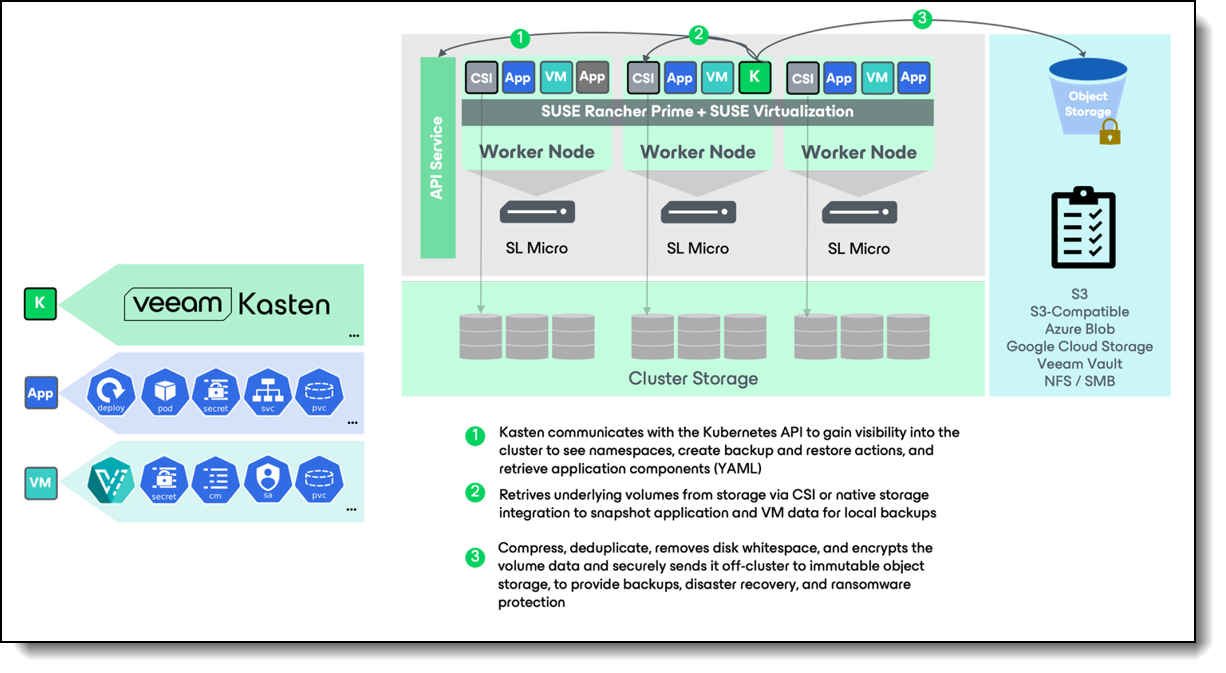
Veeam Kasten is deployed as a Helm chart directly on the SUSE Virtualization cluster, running as a Kubernetes-native application alongside the VMs it protects. The integration works as follows:
- Snapshot capture. Kasten leverages SUSE Storage volume snapshots and/or Trident CSI snapshots to capture VM disk data and associated Kubernetes metadata (virtual machine definitions, secrets, configurations).
- Export to external storage. Snapshot data is deduplicated, encrypted, and exported to configured Location Profiles --- S3-compatible object storage with object lock is recommended for ransomware protection, but NFS, SMB, cloud hyperscaler buckets, and Veeam Vault are also supported.
- Policy-driven automation. Backup frequency, retention, and scope are defined through Kasten policies that can target workloads by namespace, label, or individual VM.
- Restore and recovery. In the event of data loss, ransomware attack, or infrastructure failure, VMs can be restored to the original cluster or migrated to a different SUSE Virtualization cluster. Native File-Level Recovery enables targeted restores without full VM rollback.
- Centralized visibility. The Kasten dashboard provides dedicated visibility into VM resilience status, and optionally Kasten Multicluster Manager (MCM) can be deployed for cross-cluster observability and policy management.
The diagram below provides a conceptual view of the solution stack, illustrating Veeam Kasten flow.
Target Use Cases
Here are some customer use cases for this solution.
Enterprise Data Center Modernization
Organizations replacing legacy virtualization can consolidate VMs and containers on a single Lenovo and SUSE platform, reducing hypervisor licensing costs while gaining unified data resilience with Veeam Kasten. Finance, healthcare, and government enterprises can modernize incrementally --- migrating VMs at their own pace while all workloads are protected under one resilience framework.
Edge and Remote Office Deployments
A minimal two-node-plus witness SUSE Virtualization cluster delivers highly available virtualization for edge sites with limited IT staff. Retail, telecom, and manufacturing organizations can deploy SR630 V4 servers in compact footprints, with Veeam Kasten providing offsite replication to central data centers or cloud storage.
Hybrid Cloud and Multi-Cluster Management
Organizations spanning on-premises and cloud environments benefit from consistent management through SUSE Rancher Prime and consistent data resilience through Kasten Multi-Cluster Manager --- enabling workload protection, migration, and recovery across cluster and cloud boundaries.
Dev/Test and CI/CD Environments
Development teams can provision VMs and containers on one platform while using Veeam Kasten for self-service backup and rapid rollback of test environments, accelerating CI/CD pipelines without compromising data safety.
Key Benefits
By deploying SUSE Virtualization on Lenovo ThinkSystem V4 servers and DM/DG storage with Veeam Kasten, organizations can realize several key benefits:
Unified Operations
A single management plane through SUSE Rancher Prime manages VMs, containers, and data resilience --- eliminating the need for separate toolsets and reducing the number of interfaces, skill sets, and vendor relationships that IT teams must maintain.
Enterprise-Grade Data Resilience
Veeam Kasten delivers immutable restore points with application-centric backups, cross-cluster disaster recovery, and restore point validation --- reducing the risk of failed recoveries and undetected data loss. Combined with the DM3200F's ONTAP data services (snapshots, encryption, replication), the solution provides defense-in-depth data resilience for regulated industries.
Scalability and Flexibility
The solution scales linearly --- adding ThinkSystem nodes or expanding DM3200F storage capacity is straightforward, with Kubernetes automatically integrating new resources. The same stack supports core data center, edge, and hybrid cloud, so organizations invest in one architecture that grows with their needs.
Cost-Effectiveness
SUSE Virtualization eliminates proprietary hypervisor licensing fees. Unified data resilience through Veeam Kasten replaces the need for multiple tools --- meaning fewer licenses, fewer consoles, and lower training costs. Lenovo's high-density servers and the DM3200F's data reduction features further optimize hardware and storage spend.
Security and Compliance
Zero-trust architecture with role-based access control, end-to-end encryption, immutable restore points with object lock, and audit-ready logs provide the security posture required for compliance. Restore point validation enables teams to proactively verify recovery readiness rather than discovering gaps during an incident.
Measurable Outcomes
Organizations deploying this solution can expect:
- Accelerated deployment. SUSE Virtualization's appliance-style installation and Kubernetes automation reduce environment provisioning from weeks to hours. Veeam Kasten deploys via a single Helm chart, enabling data resilience readiness within minutes of cluster deployment.
- More efficient resource utilization. Co-locating VMs and containers on the same infrastructure with near-native performance eliminates unnecessary overhead, enabling organizations to run more workloads on fewer servers.
- Improved manageability. Unified management of virtualization, containers, and data resilience through a single control plane reduces administrative overhead and enables IT teams to reallocate effort from maintenance to innovation.
- Reduced total cost of ownership. Elimination of proprietary licensing, consolidation of resilience tools, efficient hardware utilization, and policy-driven automation contribute to measurable reductions in both capital and operational expenditure over the solution lifecycle.
- Strengthened data resilience posture. Automated, immutable restore points with cross-cluster recovery and Native File-Level Recovery capabilities ensure faster recovery times, reduced data loss risk, and improved compliance readiness
Pre-Configured Solutions
Lenovo offers pre-configured and tested solutions to simplify deployment.
Server Only Solution
This is a Server-only version with internal storage. Based on the Lenovo ThinkSystem SR630 V4 server.

Figure 2. Virtualization Server SR630 V4
The following table lists the solution specifications.
Server and Storage Solution
This solution adds a Storage Array. Based on the Lenovo ThinkSystem SR630 V4 server and the Lenovo ThinkSystem DM3200F.
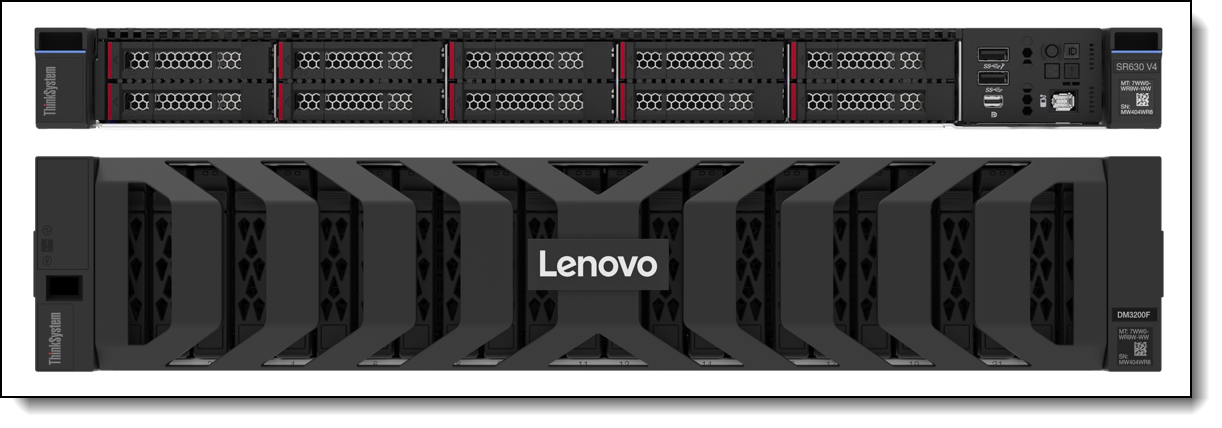
Figure 3. Virtualization Server SR630 V4 and ThinkSystem DM3200F Storage Array
The following table lists the solution specifications for server and storage.
Lenovo solutions for SUSE Virtualization can be configured by using the Lenovo Data Center Solution Configurator (DCSC).
The SUSE SIDs are available in DCSC.
Kasten Backup Instance Licensing
Licensing and Sizing Rules. 1 x Veeam Kasten subscription per Worker Node node/per year (1-5 years) with Standard Support included.
The following table is an example for customer looking for a 3-year Kasten with Standard support for a 1 worker node environment.
*This PN will be replaced soon as a new offering comes to the market
Solution Architecture
The diagram below provides a conceptual view of the solution architecture, illustrating how the four layers fit together into a unified platform:
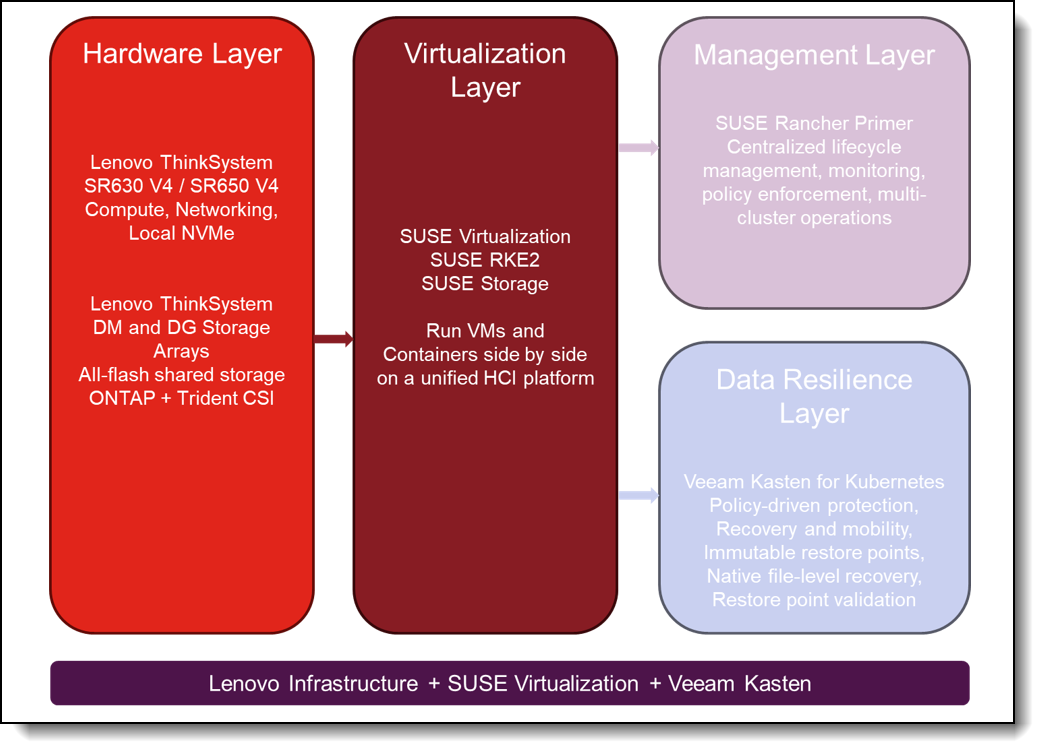
Hardware Layer. Lenovo ThinkSystem SR630 V4 and SR650 V4 servers provide compute, local NVMe storage, and networking. The Lenovo ThinkSystem DM3200F provides enterprise all-flash shared storage connected via iSCSI, NVMe/FC, or NVMe/TCP and integrated through CSI drivers (NetApp Trident).
Virtualization Layer. SUSE Virtualization delivers a Kubernetes-first HCI model using KubeVirt for VM lifecycle management, Multus for multi-network pod and VM connectivity, Kube-OVN for overlay networking with VPC isolation, and SUSE Storage for distributed block storage — all orchestrated through the Kubernetes API.
Management Layer. SUSE Rancher Prime provides centralized multi-cluster management, lifecycle orchestration, monitoring, and policy enforcement across all Kubernetes and virtualization resources.
Data Resilience Layer. Veeam Kasten deploys on the SUSE Virtualization cluster as a Kubernetes-native application, providing policy-driven resilience, recovery, and mobility for both VMs and containers. Backups are exported via Location Profiles to S3-compatible immutable storage, cloud buckets, NFS, SMB, or Veeam Vault for offsite retention and cross-cluster recovery.
Together, these layers deliver an architecture that handles traditional enterprise virtualization and cloud-native containerized applications with equal capability --- providing the performance, scalability, resilience, and freedom of infrastructure choice required for modern hybrid data centers.
For More Information
For more information about Lenovo solutions, contact your Lenovo representative or Business Partner, or visit Lenovo servers.
Related publications and links
For more information, see these resources:
- Reference Architecture:
https://lenovopress.lenovo.com/lp2360-reference-architecture-for-suse-rancher-on-lenovo-thinksystem-v4-servers - SUSE Solution Brief:
https://lenovopress.lenovo.com/lp2340-suse-rancher-prime-on-lenovo-thinksystem-v4-servers - SUSE Virtualization Solution Brief:
https://lenovopress.lenovo.com/lp2403-suse-virtualization-on-lenovo-thinksystem-v4 - Veeam Kasten:
https://www.veeam.com/blog/suse-virtualization-support-kasten.html - SUSE & Veeam Kasten:
https://www.veeam.com/solutions/alliance-partners/kubernetes/suse.html?ad=alliance-partner - Protect SUSE Virtualization Workloads with Veeam Kasten:
https://documentation.suse.com/trd/veeam/single-html/gs_virtualization_veeam-kasten/gs_virtualization_veeam-kasten.html
Trademarks
Lenovo and the Lenovo logo are trademarks or registered trademarks of Lenovo in the United States, other countries, or both. A current list of Lenovo trademarks is available on the Web at https://www.lenovo.com/us/en/legal/copytrade/.
The following terms are trademarks of Lenovo in the United States, other countries, or both:
Lenovo®
ThinkSystem®
XClarity®
The following terms are trademarks of other companies:
Intel®, the Intel logo and Xeon® are trademarks of Intel Corporation or its subsidiaries.
Helm® is a trademark of Microsoft Corporation in the United States, other countries, or both.
Other company, product, or service names may be trademarks or service marks of others.
Configure and Buy
Please select a locale
Full Change History
Course Detail
Employees Only Content
The content in this document with a is only visible to employees who are logged in. Logon using your Lenovo ITcode and password via Lenovo single-signon (SSO).
The author of the document has determined that this content is classified as Lenovo Internal and should not be normally be made available to people who are not employees or contractors. This includes partners, customers, and competitors. The reasons may vary and you should reach out to the authors of the document for clarification, if needed. Be cautious about sharing this content with others as it may contain sensitive information.
Any visitor to the Lenovo Press web site who is not logged on will not be able to see this employee-only content. This content is excluded from search engine indexes and will not appear in any search results.
For all users, including logged-in employees, this employee-only content does not appear in the PDF version of this document.
This functionality is cookie based. The web site will normally remember your login state between browser sessions, however, if you clear cookies at the end of a session or work in an Incognito/Private browser window, then you will need to log in each time.
If you have any questions about this feature of the Lenovo Press web, please email David Watts at dwatts@lenovo.com.


