

Top
Authors
Published
27 Apr 2026Form Number
LP2428PDF size
11 pages, 409 KBSubscribed to LP2428.
Thank you for your feedback.
Abstract
This document summarizes Microsoft SQL Server 2025 performance on Lenovo ThinkSystem SR850 V4 and SR860 V4 servers running Windows Server 2025. The platforms combine four Intel Xeon 6700P series processors, large DDR5 memory capacity, and PCIe Gen5 NVMe storage to deliver stable OLTP throughput and efficient utilization of compute and I/O resources. Performance testing using the HammerDB TPC C workload confirmed sustained high transaction rates under load without reliance on shared or software-defined storage.
The paper provides configuration guidance and highlights the simplified management enabled by Windows Server 2025 and SQL Server 2025. The paper is for IT architects, database administrators, and technical decision makers evaluating scale-up platforms for modern SQL Server deployments.
Introduction
Modern data center environments require infrastructure that can support large memory footprints, high core density, flexible storage, and consistent virtualization management for browser-based management of Windows Server environments running on physical or virtual infrastructure.
Lenovo ThinkSystem SR850 V4 combines these Windows Server 2025 capabilities with a four-socket, large-memory server platform designed for demanding data-centric workloads. Lenovo positions the SR850 V4 for use cases such as databases, in-memory databases, analytics, business intelligence, data lakes and OLTP, where processor scale, memory capacity and expansion flexibility matter more than compact entry-level density.
This technical brief focuses on Microsoft SQL Server 2025 deployed on Lenovo ThinkSystem SR850 V4 running Windows Server 2025. SQL Server 2025 extends the SQL Server platform with continued improvements in performance, availability and management, while the SR850 V4 provides the underlying compute and memory scale required for large transactional and analytical workloads.
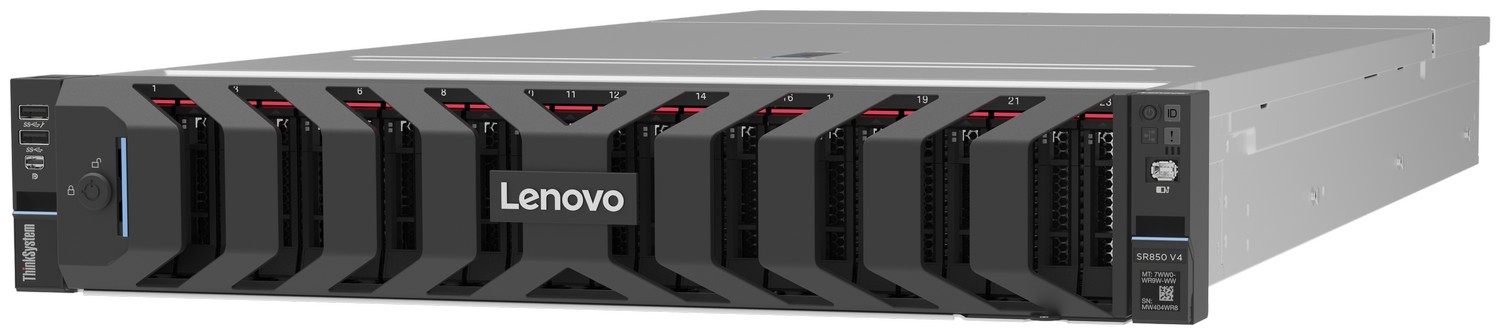
Figure 1. Lenovo ThinkSystem SR850 V4
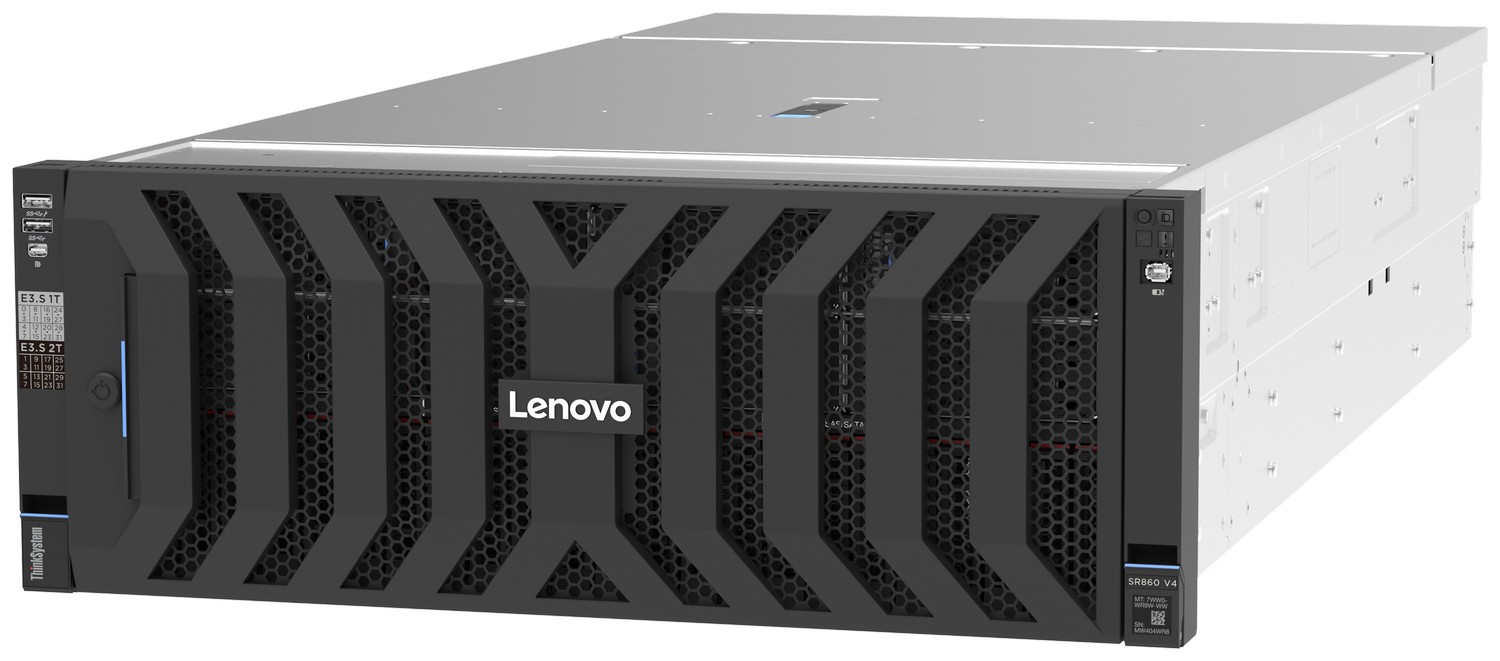
The SR850 V4 is a 4‑socket large‑memory platform in a dense 2U design. It supports up to 24x 2.5‑inch hot‑swap SAS, SATA or NVMe drive bays, or up to 32x E3.S 1T NVMe bays depending on the chosen front‑bay configuration. The system provides PCIe Gen5 connectivity and can operate all NVMe bays without lane oversubscription, which ensures predictable storage throughput for transactional and analytical workloads. Storage layouts can also include M.2 boot drives, with support for up to two internal non‑hot‑swap M.2 drives or up to two rear hot‑swap M.2 drives in configurations equipped with three risers.The ThinkSystem SR860 V4 is architecturally similar to the SR850 V4 but in a 4U form factor, for even more storage and connectivity support for even better scaling and workload balance.
The internal architecture supports up to four Intel Xeon 6700P‑series processors (performance cores), has 64 slots for DDR5 DIMMs and can support up to 16TB of memory if 256GB 3D RDIMMs are used. This design targets workloads with high memory intensity, including in‑memory databases, analytics, and OLTP systems.
Key benefits
The solution offers the following benefits:
- High SQL Server performance: The ThinkSystem SR850 V4 and SR860 V4 servers deliver strong SQL Server 2025 performance through Intel Xeon 6700P-series processors, high‑speed DDR5 memory, and direct‑attached NVMe storage. Local NVMe drives provide predictable, low‑latency throughput for OLTP and analytical.
- Consistent and scalable compute: The 4‑socket SR850 V4 architecture supports large memory footprints and high core density, enabling stable performance for memory‑intensive SQL Server workloads such as in‑memory OLTP, analytics, and business intelligence.
- Simplified deployment and operations: Windows Server 2025 and SQL Server 2025 provide management tools through Windows Admin Center and SQL Server Management Studio offering streamlined provisioning, monitoring, and lifecycle operations for standalone servers without cluster‑specific configuration
- Optimized platform efficiency: PCIe Gen5 connectivity and non‑oversubscribed NVMe lanes ensure sustained storage bandwidth under load, supporting high‑throughput database activity. The platform's power‑efficient CPU options enable reliable performance per watt for SQL Server deployments.
- Enterprise reliability: The SR850 V4 incorporates redundant power, advanced cooling and robust mechanical design for continuous SQL Server operation. The platform also supports Lenovo's direct water‑cooling infrastructure through the Processor Neptune Core Module and in‑rack manifold assemblies, providing stable thermal behavior under sustained load
Excellent value
The Lenovo ThinkSystem SR850 V4 and SR860 V4 servers deliver strong value by combining Lenovo server engineering with a high‑performance 4‑socket architecture optimized for data‑centric workloads.
These platforms provide the following benefits:
- Powerful compute and memory scalability, with support for Intel Xeon 6700P‑series processors, up to 16 TB of DDR5 memory, and up to 12x PCIe slots ( 11x Gen5 + 1x Gen4), the SR850 V4 provides a balanced architecture for SQL Server 2025 deployments requiring large memory footprints, sustained CPU performance, and high‑bandwidth expansion
- High‑performance local storage, the system supports a wide range of NVMe drive configurations with non‑oversubscribed PCIe connectivity, ensuring predictable, low‑latency performance for transactional and analytical database workloads without relying on Storage Spaces Direct or cluster‑based storage
- Operational efficiency and simplified management, Lenovo XClarity Controller 3 (XCC3) consolidates management functions into a single interface, offering enhanced remote management, improved security options, and streamlined lifecycle operations for standalone SQL Server environments running on Windows Server 2025.
- Thermal efficiency with optional liquid cooling, the optional Lenovo Neptune liquid‑cooling module increases sustained performance by improving heat dissipation and reducing cooling overhead, delivering long‑term operational value in high‑demand SQL Server environments
Standard specifications
The following table lists the key specifications for the SR850 V4 and SR860 V4.
Microsoft SQL Server 2025
SQL Server 2025 (17.x) builds on SQL Server 2022 by extending Intelligent Query Processing, improving performance, enhancing availability features, and adding new language, developer, and platform capabilities. It continues Microsoft’s direction of offering a unified data platform across on‑premises, hybrid, and cloud environments.
As with SQL Server 2022, SQL Server 2025 does not install R, Python, or Java runtimes through SQL Setup. Users install any required custom runtimes separately.
Performance enhancements in SQL Server 2025 include:
- Improvements to Query Store and Intelligent Query Processing, enabling broader plan optimization and more adaptive execution behavior
- Native JSON enhancements, including support for large JSON documents and improved indexing options.
- Optimized locking to reduce database contention and improve concurrency without code changes
- TempDB and metadata engine improvements that enhance scalability and workload
- In‑memory OLTP improvements for better engine efficiency and workload consistency
Management improvements include:
- Deeper Azure integration, including Fabric shortcuts, semantic search, and cloud‑connected management capabilities
- New linkage options for hybrid deployments using Azure SQL and Microsoft Fabric
- Always On Availability Group enhancements continue with improved failover behavior and better integration with modern cloud architectures
- Accelerated Database Recovery (ADR) remains a core engine feature for faster recovery.
ThinkSystem SR850 V4 server provide the performance and flexibility required for both bare‑metal and virtualized SQL Server deployments running on Windows Server 2025. The platform supports Hyper‑V virtualization and leverages native Windows Server capabilities, combined with high‑speed DDR5 memory and direct‑attached NVMe storage, to deliver low‑latency and consistent throughput for OLTP and analytical workloads. PCIe Gen5 connectivity ensures that NVMe devices operate without lane oversubscription, enabling sustained I/O performance under database load.
Windows Server natively supports advanced technologies such as NVMe storage and RDMA‑capable networking adapters, allowing SQL Server 2025 to take full advantage of the SR850 V4 hardware platform. These capabilities enable efficient data movement, reduced overhead and high performance for demanding SQL Server environments without requiring software‑defined storage layers.
Tested configuration
The configuration used for testing has the following configuration:
- Server: Lenovo ThinkSystem SR850 V4
- Processor: 4 x Intel Xeon 6788P Processor up to 3.8 GHz (2 GHz base) with 86 cores and 172 threads each
- Memory: 4TB of DDR5 6400 MT/s memory
- DB Storage: 14x ThinkSystem 7500 NVMe drives 3.8TB NVMe SSDs PCIe 4.0
- OS Storage: 2x 960GB M.2 NVMe SSDs PCIe 4.0 for the operating system (RAID 1)
- OS: Windows Server 2025 Datacenter
- Networking: 1 x Mellanox ConnectX-6 Lx 10/25GbE SFP28 2-port PCIe Ethernet Adapter
Best practices for performance
To achieve the best performance from the hardware, configure the system using the following settings:
- Configure UEFI settings to set Operating mode to Maximum performance.
- Enable Hyper-Threading in the UEFI.
- Configure power profile in Windows Server to "High performance".
- SQL Server database and log drives are recommended to be formatted with 64KB NTFS cluster size.
- SQL Server database and log files should be on separate physical drives. The OS and SQL Server binary drives are recommended to be formatted with standard 4KB NTFS cluster size. TempDB is shared by many processes and users as a temporary working area and should be configured appropriately. Default configuration will be suitable for most workloads. Use the install experience for guided configuration
- If the server is dedicated to the SQL Server workload, use the default dynamic memory management model or follow Microsoft SQL documentation guidelines for manually configuring memory options if finer grain control is desired.
Performance testing and results
The testing was performed under the following conditions:
- Windows Server 2025 Datacenter Edition
- Six SQL instances were configured with access to two NUMA nodes each
- The TPCC databases were split between the storage drives
- HammerDB was used as the workload generator, specifically running the TPC‑C benchmark to simulate an OLTP workload.
- Six HammerDB threads started, each thread targeting a one of the SQL instance
Results:
Across the SQL Server 2025 deployment, the test configuration delivered a total throughput of 33,041,273 TPM.
This result demonstrates the ability of the ThinkSystem SR850 V4 platform to sustain high transaction volumes under OLTP load while maintaining consistent performance characteristics.
The combination of Intel Xeon 6700P‑series processors, large DDR5 memory capacity, and direct‑attached NVMe storage enables SQL Server 2025 to efficiently utilize available compute and I/O resources. The results reflect stable execution without dependence on shared or software‑defined storage layers, highlighting the effectiveness of locally attached NVMe for transactional database workloads.
HammerDB was used as the workload generation tool for performance validation. HammerDB is an open‑source benchmarking framework that implements industry‑standard workloads and can automate large‑scale transactional testing. More information about HammerDB is available at: https://www.hammerdb.com
The TPC‑C workload used in this test is defined by the Transaction Processing Performance Council and represents a classic OLTP profile composed of order entry, payment, delivery and stock‑level transactions. Full details on the TPC‑C benchmark specification can be found at: https://www.tpc.org
Bill of Materials
The following table lists the components of the server we used for testing.
References
For more information, see these resources:
- Microsoft SQL 2025
What's New in SQL Server 2025 - SQL Server | Microsoft Learn - Lenovo ThinkSystem SR850 V4
SR850 V4 Server Product Guide
Authors
Laurentiu Petre is a Lenovo solutions engineer working in Bucharest, Romania. He has over 10 years of experience in the IT field being accustomed with large scale deployments of Microsoft Exchange and other Microsoft products. Before Lenovo, he managed the infrastructure of key players in telecommunications and petroleum exploitation companies. Laurentiu is currently working on SQL performance and Microsoft cloud solutions such as Edge Cloud.
Vinay Kulkarni is a Principal Technical Consultant in the Software and Solutions Development group at ISG, Lenovo. His current focus is on solution architectures in the areas of cloud, database analytics and AI. Vinay has more than 20 years’ experience with Lenovo, and IBM. During this time, Vinay has led diverse projects ranging from performance benchmark publications to solutions development, as well as business and technical strategy.
Trademarks
Lenovo and the Lenovo logo are trademarks or registered trademarks of Lenovo in the United States, other countries, or both. A current list of Lenovo trademarks is available on the Web at https://www.lenovo.com/us/en/legal/copytrade/.
The following terms are trademarks of Lenovo in the United States, other countries, or both:
Lenovo®
AnyBay®
Neptune®
ThinkSystem®
XClarity®
The following terms are trademarks of other companies:
Intel®, the Intel logo and Xeon® are trademarks of Intel Corporation or its subsidiaries.
Microsoft®, Azure®, NTFS®, SQL Server®, Windows Server®, and Windows® are trademarks of Microsoft Corporation in the United States, other countries, or both.
TPC® is a trademark of Transaction Processing Performance Council.
Other company, product, or service names may be trademarks or service marks of others.
Configure and Buy
Please select a locale
Full Change History
Course Detail
Employees Only Content
The content in this document with a is only visible to employees who are logged in. Logon using your Lenovo ITcode and password via Lenovo single-signon (SSO).
The author of the document has determined that this content is classified as Lenovo Internal and should not be normally be made available to people who are not employees or contractors. This includes partners, customers, and competitors. The reasons may vary and you should reach out to the authors of the document for clarification, if needed. Be cautious about sharing this content with others as it may contain sensitive information.
Any visitor to the Lenovo Press web site who is not logged on will not be able to see this employee-only content. This content is excluded from search engine indexes and will not appear in any search results.
For all users, including logged-in employees, this employee-only content does not appear in the PDF version of this document.
This functionality is cookie based. The web site will normally remember your login state between browser sessions, however, if you clear cookies at the end of a session or work in an Incognito/Private browser window, then you will need to log in each time.
If you have any questions about this feature of the Lenovo Press web, please email David Watts at dwatts@lenovo.com.


