

Top
Published
25 Sep 2026Form Number
LP2533PDF size
14 pages, 1.2 MBSubscribed to LP2533.
Thank you for your feedback.
Abstract
Nutanix Agentic AI combines Nutanix Enterprise AI, Nutanix Kubernetes Platform, and Nutanix Cloud Infrastructure to run and govern agentic applications across private data centers and public clouds. Lenovo ThinkAgile HX V4 and FX V4 systems with Intel Xeon 6 processors provide the integrated on-premises infrastructure for this stack. Intel testing of Nutanix Enterprise AI 2.5 on a Lenovo ThinkSystem SR650 V4 showed up to 2x the output throughput of the prior generation, and Lenovo testing on ThinkAgile HX650 V4 kept Llama 3 8B second-token latency below 100 ms through batch size 8. This brief describes the architecture, use cases, and a CPU-first path to private enterprise AI.
Introduction
Agentic applications extend the request path well beyond a single prompt and response. A typical agent selects a model, retrieves enterprise data, calls one or more tools, evaluates intermediate results, and repeats those steps before returning an answer or taking an approved action. Each user request can therefore generate many model calls and infrastructure interactions.
Nutanix Agentic AI addresses this pattern by combining Nutanix Enterprise AI, Nutanix Kubernetes Platform, and Nutanix Cloud Infrastructure into a single platform to run and govern agentic applications. Because agent applications can run anywhere and use any model for inference, Nutanix Enterprise AI and Nutanix Agent Gateway support deployment across both private data centers and public clouds, with one control plane to deploy, manage, route, and fail over agents and large language model (LLM) inference across those environments.


Figure 1. ThinkAgile HX650 V4 (top) and HX630 V4 (bottom) for Nutanix hyperconverged infrastructure
For data, models, and workloads that must stay on premises, Lenovo ThinkAgile HX V4 and FX V4 systems with Intel Xeon 6 processors provide the integrated infrastructure. Intel and Lenovo testing on these platforms shows that 8-billion-parameter (8B) models can be served on CPU with up to 2x the throughput of the prior generation and sub-100 ms second-token latency, giving organizations a practical, CPU-first starting point for private inference.
This brief describes the business challenges, the solution architecture, representative use cases and industries, the test results, business outcomes, and a reference bill of materials.
Business Challenge
Most organizations have moved past asking whether agentic AI can help the business and are now asking how to run it safely and predictably at scale. Early pilots often succeed with a single model, a small team, and a handful of users. Production is different: agents act on real enterprise data and systems, many teams depend on the same platform, and response times and costs must hold up under real demand. At the same time, sensitive data, regulated workloads, and data residency rules keep much of this work in the private data center, even when some models or applications run in the public cloud.
As a result, organizations moving agentic AI from pilot to production typically run into three challenges:
- Control of data and model access:
Agents combine user instructions, retrieved documents, model outputs, and tool results. Authorization decisions must stay consistent across all of those paths, and keeping inference on premises does not remove the need for identity, endpoint policy, logging, and approval controls.
- Operational complexity:
An agent platform can include inference servers, Kubernetes clusters, model registries, vector databases, object and file storage, network policy, and monitoring. Treating each as a separate project multiplies lifecycles and support boundaries across AI, platform, infrastructure, data, and security teams.
- Concurrency and service levels:
A multi-step agent can issue several model requests for one business transaction. Capacity planning must account for concurrent prompts, token distributions, time to first token, time per output token, tool latency, and step count. An average token rate alone cannot predict application response time.
Left unaddressed, these challenges slow time to value, raise the risk of data exposure or unapproved actions, and lead to either overbuilt infrastructure or missed service levels. Organizations need a platform that brings governance, operations, and capacity planning together from the start.
Solution
The Lenovo and Nutanix solution separates application concerns from shared infrastructure, so that each team owns a clear layer on a single operational foundation. The figure below shows the architecture: the Nutanix Enterprise AI control plane and Nutanix Agent Gateway span hybrid environments, while ThinkAgile HX V4 and FX V4 systems host the on-premises layers.
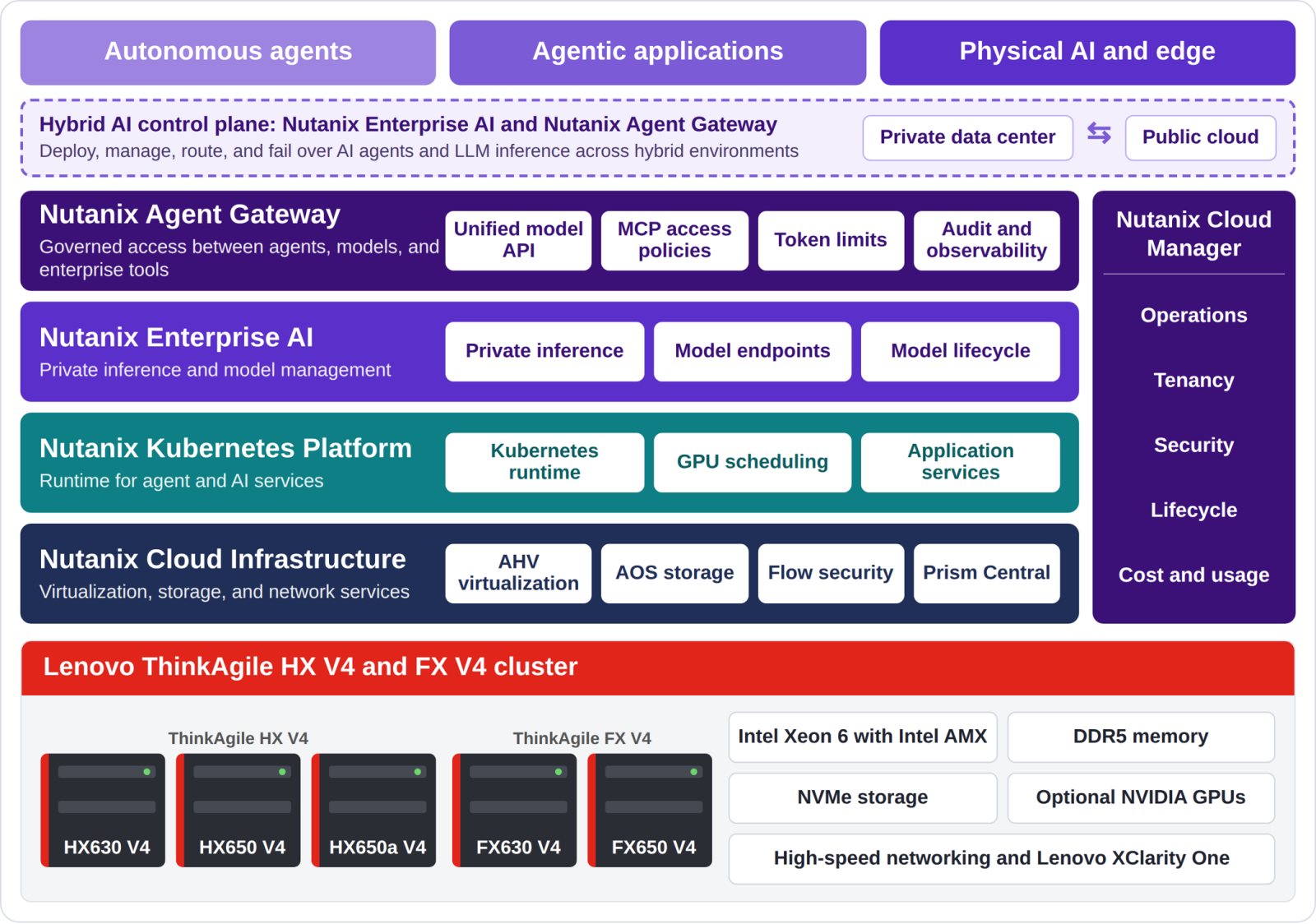
Figure 2. Nutanix Agentic AI architecture with hybrid control plane on Lenovo ThinkAgile HX V4 and FX V4
As the figure above illustrates, the solution is built as a stack of layers, each with a clear role. At the top, Agent Gateway and Nutanix Enterprise AI govern how agents reach models and tools and how inference endpoints are managed. Beneath them, Nutanix Kubernetes Platform provides the runtime for agent and AI services, while Nutanix Cloud Infrastructure and data services supply the virtualization, storage, networking, and management foundation. The private layers of this stack run in the organization's data center on Lenovo ThinkAgile HX V4 and FX V4 systems, where Intel Xeon 6 processors with built-in Intel Advanced Matrix Extensions (Intel AMX) accelerate AI inference directly on the CPU, so private models can be served without dedicated accelerators.
Agent Gateway and inference management
Nutanix Enterprise AI serves as the centralized AI control plane for Agent Gateway and inference management. Agent Gateway standardizes how agents reach language models, Model Context Protocol (MCP) servers, and enterprise applications, with consistent authentication, observability, token-based rate limiting, usage accountability, and support for private and cloud-hosted model endpoints.
Nutanix Enterprise AI
Nutanix Enterprise AI provides model endpoint deployment and lifecycle functions so that platform teams can offer models as a shared service. This separates model operation from each application team's code and lets endpoint, model, and capacity changes be managed centrally. The Intel testing in this brief used Nutanix Enterprise AI 2.5 with vLLM 0.13.0 as the serving stack.
Nutanix Kubernetes Platform
Nutanix Kubernetes Platform supplies the Kubernetes environment for agent services and adjacent AI tools, with catalog categories that include notebooks, vector databases, MLOps engines, and agent frameworks. For production use, platform teams should standardize a supported subset, control images and dependencies, and separate development and production namespaces and credentials.
Infrastructure and data services
Nutanix Cloud Infrastructure provides the foundation: AHV supplies the virtualization boundary, AOS provides distributed storage, Prism provides cluster operations, and Flow supplies networking and security controls. Nutanix Unified Storage and Nutanix Data Services for Kubernetes support shared file, object, block, and persistent Kubernetes data, depending on the application design. CPU-only and accelerator-backed model servers use the same operational foundation, although the bill of materials and performance profile differ.
Nutanix Cloud Manager (NCM), shown alongside the stack in the figure above, adds management capabilities for operations, tenancy, security, lifecycle, and cost and usage across the environment.
On-premises deployment scope
In this design, private models, the Agent Gateway, Kubernetes services, application services, and the related data paths are all hosted in the organization's data center. The default reference path is private inference on ThinkAgile HX V4 and FX V4 clusters, so prompts, retrieved documents, and model outputs for sensitive workloads remain within the organization's control boundary.
Agent Gateway can also present governed access to public model services. Using those services changes the data flow and residency assessment, so a hosted model should be routed as a separate endpoint with explicit data classification, logging, rate limits, and cost controls. Gateway policy complements, rather than replaces, authorization inside the called application or MCP server.
Lenovo ThinkAgile HX V4 and FX V4 infrastructure
Lenovo ThinkAgile HX V4 systems are integrated Nutanix hyperconverged infrastructure (HCI) appliances. ThinkAgile FX V4 systems are factory-integrated multi-vendor HCI platforms that can run Nutanix AOS and AHV, giving organizations the option to standardize on one hardware platform while keeping software stack choice. Both families run the same Nutanix software layers.


Figure 3. ThinkAgile FX650 V4 (top) and FX630 V4 (bottom) designed for flexible hyperconverged infrastructure
The table below summarizes the role of each model in this solution.
Refer to the Lenovo product guides for the supported processor, memory, storage, networking, and accelerator combinations. All models are managed with Lenovo XClarity One and backed by Lenovo support.
Intel Xeon 6 and CPU inference
Intel Xeon 6 processors build AI acceleration into every core through Intel Advanced Matrix Extensions (Intel AMX), which accelerate the matrix multiplication at the heart of transformer inference. Intel AMX supports bfloat16 for training and inference and int8 for inference, and frameworks use it through Intel Extension for PyTorch and other optimized libraries, so applications benefit from AMX acceleration through standard AI frameworks.
Running inference on the CPU lets model endpoints share the same ThinkAgile nodes, virtualization layer, and operational model as the rest of the Nutanix cluster. Higher core counts, such as the 64-core Xeon 6767P, and DDR5-6400 memory increase the concurrency and token rate each node can serve, as the Workloads section shows.
CPU inference is a strong fit when:
- Models are in the 8B class or smaller, such as retrieval, summarization, classification, and tool-selection steps in an agent pipeline.
- Concurrency is moderate and latency targets are in the range of about 100 ms per output token.
- Data must stay local and operational simplicity matters more than maximum token throughput.
Larger models, long contexts, or high concurrency may require accelerator-backed configurations such as the ThinkAgile HX650a V4. Because both run on the same Nutanix foundation, teams can start with CPU inference and add GPU capacity without changing how endpoints are governed or operated.
Use Cases
Agentic AI on this platform supports a broad range of enterprise workflows. The table below summarizes representative on-premises use cases, the agent behavior involved, and the controls each one requires.
Start with use cases where actions can remain read-only or require human approval. Grant write access only after the team has measured tool selection accuracy, failure handling, audit completeness, and rollback procedures.
The following examples show how three of these use cases apply in practice:
- Enterprise knowledge assistant
Employees need answers grounded in internal policies, procedures, and technical documentation that cannot leave the data center. The agent retrieves approved content and generates a cited answer using a private model endpoint on Nutanix Enterprise AI, with document permissions and grounding checks enforced along the retrieval path. Financial services, healthcare, and professional services firms gain assistant capabilities without sending confidential content to a hosted model.
- Service and platform operations assistant
IT operations teams face alert volume that outpaces staff. The agent summarizes incidents, queries telemetry, correlates alerts, and proposes diagnostic or runbook steps, then opens or updates tickets after human approval. Agent Gateway governs access to MCP and API connectors, services run on Nutanix Kubernetes Platform, and read-only defaults with action logging keep the blast radius small while the team measures accuracy.
- Document review workflow
Manufacturing, public sector, and legal teams process large volumes of contracts, quality records, and case files. The agent extracts fields, compares documents to policy, and routes exceptions to a reviewer. Private inference, durable document storage on Nutanix data services, and workflow state on the same cluster keep sensitive records local and traceable.
Market Verticals
Organizations in regulated and data-sensitive industries are among the strongest candidates for on-premises agentic AI, because they need AI capabilities while keeping sensitive data, models, and audit records under their own control. The following table shows the primary design concern and representative applications for each industry.
Industry labels do not determine compliance. Each deployment must map its actual data, users, model behavior, tool permissions, record retention rules, and control evidence to the organization's legal and security requirements.
Workloads
Two separate test programs characterize CPU inference for 8-billion-parameter Llama models on Intel Xeon 6, a common model size for retrieval, summarization, and tool-selection steps in agentic applications. The two result sets use different models, runtimes, software versions, and latency definitions, so they are presented separately and should not be combined.
Intel testing: Nutanix Enterprise AI 2.5 on Xeon 6
Intel tested Nutanix Enterprise AI 2.5 with vLLM 0.13.0 serving Llama 3.1 8B Instruct at an approximately 100 ms time per output token (TPOT) service level. The configurations were:
- Xeon 6 system: Lenovo ThinkSystem SR650 V4 with 2 x Intel Xeon 6745P (32 cores, 300 W) and 512 GB DDR5-6400. The SR650 V4 is the base server for ThinkAgile HX650 V4, which supports the Xeon 6745P.
- Comparison system: Lenovo ThinkSystem SR650 V3 with 2 x Intel Xeon Platinum 8562Y+ (32 cores, 300 W) and 512 GB DDR5-5600.
The following chart shows the number of concurrent user prompts each system supported while meeting the TPOT service level, across six combinations of input and output length.
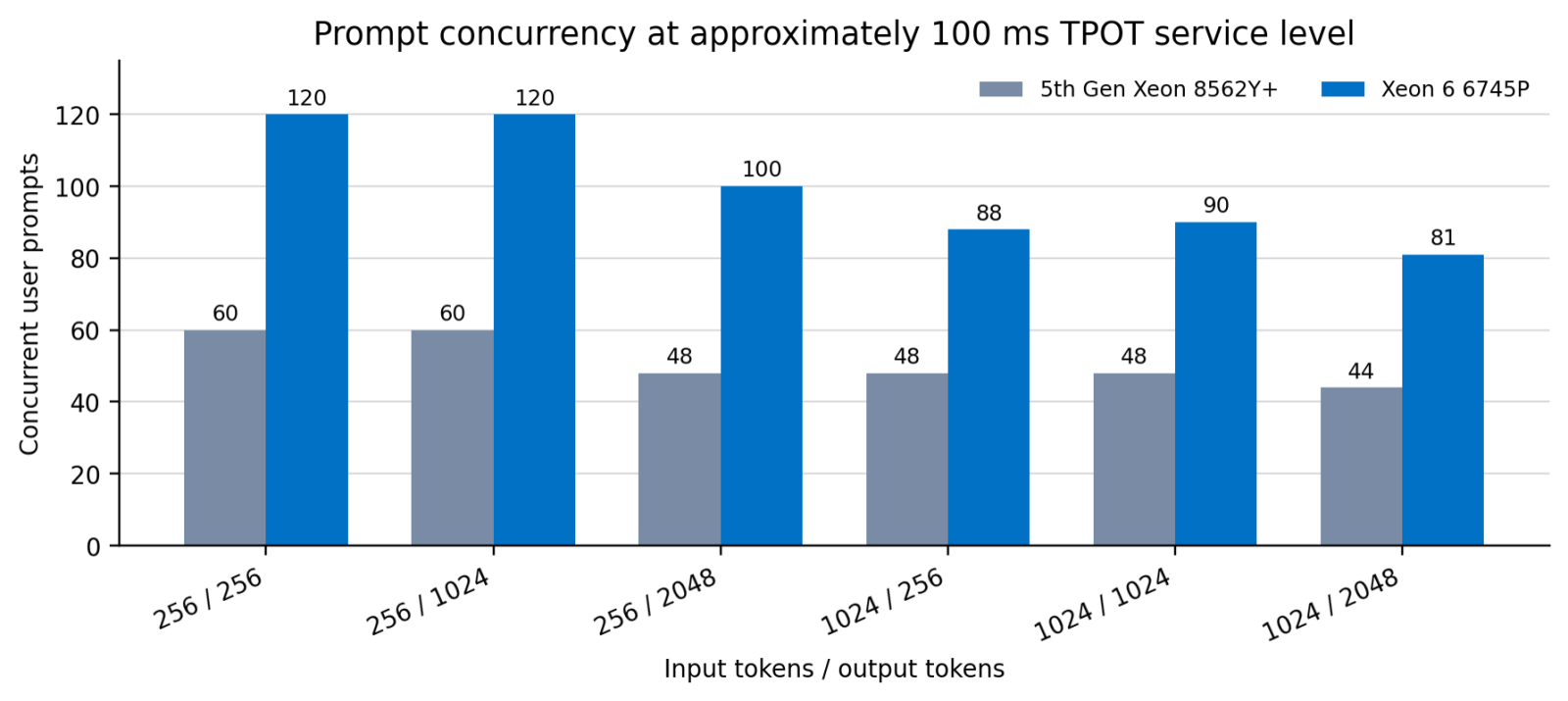
Figure 4. Intel testing: concurrent prompts meeting the approximately 100 ms TPOT service level (higher is better)
The Xeon 6 system supported 120 concurrent prompts versus 60 with 256 input tokens and 256 or 1024 output tokens, and 81 versus 44 with 1024 input and 2048 output tokens, while meeting the TPOT target. Memory speed, kernel, and firmware differed between systems, so this is a system comparison rather than a processor-only measurement.
Lenovo testing: ThinkAgile HX650 V4 cluster
Lenovo ran Llama 3 8B in bfloat16 with Intel Extension for PyTorch 2.3 and DeepSpeed 0.18.2 in a single Ubuntu 24.04 virtual machine (240 vCPUs, 384 GB RAM) on a four-node ThinkAgile HX650 V4 cluster running Nutanix 7.3 and AHV 10.3. Each node used 2 x Intel Xeon 6767P (64 cores, 2.4 GHz) with Intel AMX and 1 TB DDR5-6400. Tests used 32 to 2048 input tokens, 256 output tokens, and batch sizes 1 to 16.
The following chart second-token average latency for each input length as batch size increases, with the 100 ms target marked for reference.
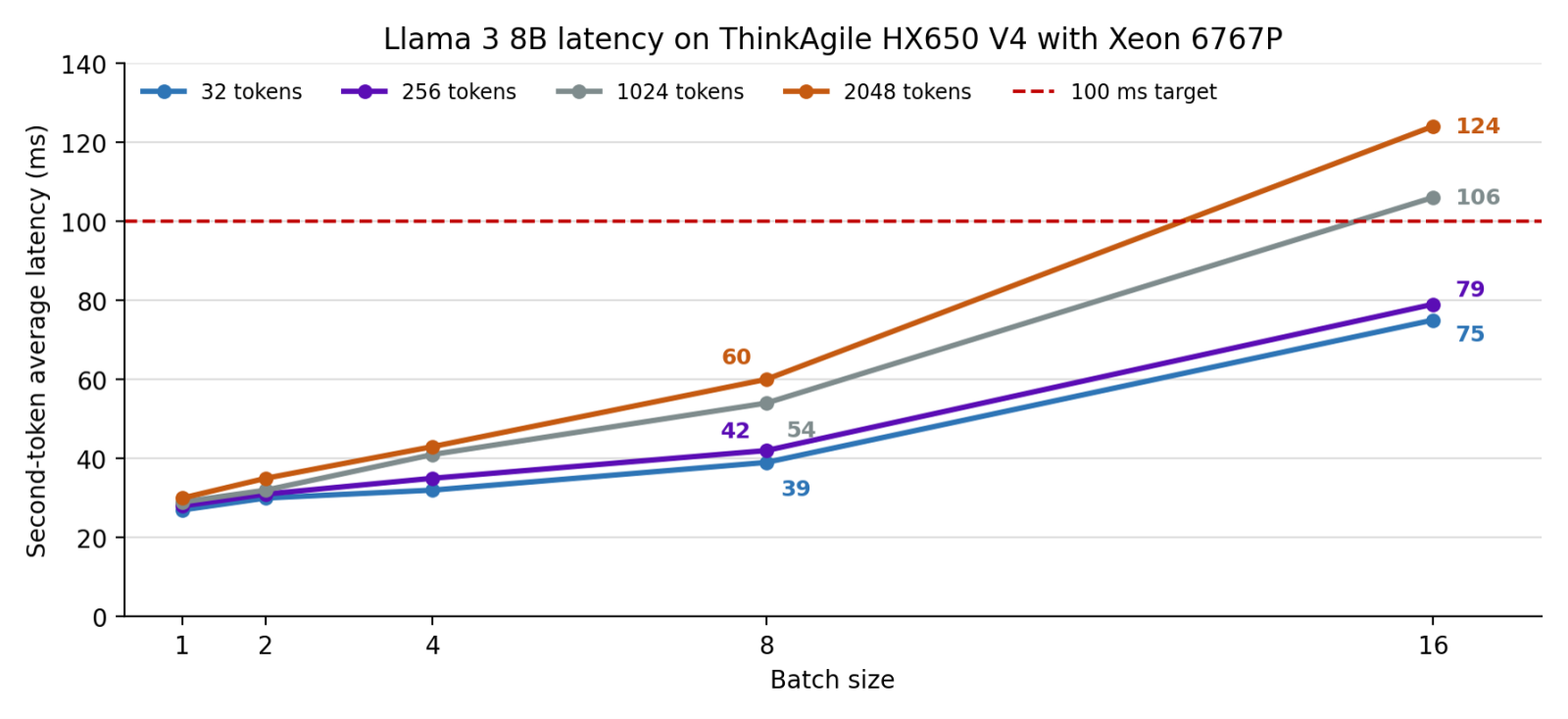
Figure 5. Lenovo testing: Llama 3 8B second-token average latency on ThinkAgile HX650 V4 with Xeon 6767P (lower is better)
Second-token average latency stayed below 100 ms through batch size 8 for every input length, making batch size 8 a practical steady-state point for prompts of about 2,000 tokens. At batch size 16, 1024-token and 2048-token inputs rose to 106 ms and 124 ms.
Notes about the tests:
- Test dates and performance:
Intel results are based on testing by Intel as of April 2, 2026. Lenovo results are based on Lenovo testing on ThinkAgile HX650 V4. Performance varies by use, configuration, and other factors. Learn more on the Intel Performance Index site. Your costs and results may vary.
- What the tests do not cover:
Both tests measure model serving, not a complete agent request. Agent Gateway policy, retrieval, MCP tool calls, and multi-step orchestration must be added in a proof of concept, with the cluster sized to carry the required load with one node unavailable.
Business Outcome
The solution delivers value on three fronts: measurable inference performance on Intel Xeon 6, simpler and more controlled operations, and a lower-risk path from pilot to production:
Performance and efficiency
The published results show that Xeon 6-based systems give a credible CPU-first starting point for private inference:
- Up to 2x output throughput: in Intel testing of Nutanix Enterprise AI 2.5 on ThinkSystem SR650 V4 versus SR650 V3, with up to 120 concurrent prompts meeting an approximately 100 ms TPOT service level.
- Up to approximately 2.3x prompts per watt: normalized to the 5th Gen Xeon system in the same Intel test.
- Sub-100 ms latency through batch size 8: in Lenovo testing on ThinkAgile HX650 V4, from 39 ms to 60 ms across 32-token to 2048-token inputs.
Serving 8B-class models on CPU also lets organizations start agentic AI projects on the same ThinkAgile nodes they use for other Nutanix workloads, and reserve GPU investment for the models and concurrency levels that measurably need it.
Operational and business value
Beyond raw performance, the architecture addresses the control, complexity, and capacity challenges described earlier. The following table summarizes how.
A lower-risk path to production
Because model serving is only one part of an agent request, a structured validation sequence before production rollout is recommended:
- Define service levels: end-to-end latency, model latency, completion rate, concurrency, and failure behavior.
- Replay real traffic: a representative mix of prompt lengths, output lengths, retrieval sizes, models, and agent step counts.
- Test the full path: include Agent Gateway policy, identity, retrieval, MCP or API calls, and the target enterprise systems.
- Test resilience: run a node failure and a maintenance event while retaining the capacity reserve the availability policy requires.
- Measure cost and power: measure power at one stated boundary and period before calculating prompts per watt or cost per successful business task.
Following this sequence turns the published benchmarks into a sizing decision grounded in the organization's own workload, which reduces the risk of over-provisioning or missing service levels after launch.
Bill of Materials
The table below lists the core items from the all-flash ThinkAgile HX650 V4 bill of materials used in Lenovo testing. It is a reference for the tested hardware, not a final production quote. The list includes Nutanix Cloud Platform but not Nutanix Enterprise AI or Nutanix Kubernetes Platform entitlements. Add those software subscriptions, support, network optics and switches, rack power, and any backup or disaster recovery components the final design requires.
Confirm exact Nutanix software versions, entitlements, firmware, and hardware compatibility with your Lenovo representative before ordering, and size the cluster for the required workload with one node unavailable.
Conclusion
Nutanix Enterprise AI governs model access and inference endpoints, Nutanix Kubernetes Platform hosts agent services, and Nutanix Cloud Infrastructure supplies the virtualized foundation. A single control plane governs agents and inference across private data centers and public clouds, while sensitive data and models stay on premises. Lenovo ThinkAgile HX V4 and FX V4 systems with Intel Xeon 6 processors deliver that on-premises foundation with integrated hardware, management, and support. Organizations can begin with read-only, human-approved agents on CPU inference, validate end to end with their own models, data, tools, and concurrency, and scale capacity as the workload proves itself.
For More Information
To learn more about Nutanix Agentic AI on Lenovo ThinkAgile HX V4 and FX V4 systems, contact your Lenovo representative or Lenovo Business Partner, or visit the resources below.
References:
- Intel Xeon 6 Processors and Nutanix Enterprise AI Deliver 2x Higher Throughput on LLM Inferencing, Intel Community blog:
https://community.intel.com/t5/Blogs/Tech-Innovation/Artificial-Intelligence-AI/Intel-Xeon-6-Processors-and-Nutanix-Enterprise-AI-Deliver-2x/post/1747665 - Deploy and Scale Generative AI in Enterprises with Intel AMX and Lenovo ThinkAgile HX V4 and FX V4 (LP2362):
https://lenovopress.lenovo.com/lp2362 - Intel Performance Index:
https://edc.intel.com/content/www/us/en/products/performance/benchmarks/overview/ - Multi-Vendor Hyperconverged Infrastructure with Lenovo ThinkAgile FX V4 (LP2520):
https://lenovopress.com/lp2520 - Lenovo ThinkAgile HX650 V4 Product Guide:
https://lenovopress.lenovo.com/lp2133 - Lenovo ThinkAgile HX630 V4 Product Guide:
https://lenovopress.lenovo.com/lp2132 - Lenovo ThinkAgile FX650 V4 Product Guide:
https://lenovopress.lenovo.com/lp2338 - Lenovo ThinkAgile FX630 V4 Product Guide:
https://lenovopress.lenovo.com/lp2337 - Nutanix Agentic AI solution:
https://www.nutanix.com/solutions/ai - Lenovo ThinkAgile HX and FX reference architecture:
https://lenovopress.lenovo.com/lp0665
Authors
Chandrakandh Mouleeswaran is a Solution Architect with 18+ years of experience in software development, performance testing and engineering, having worked on designing and architecting many scalable enterprise applications. He has spent a decade in technical enablement and partner solution development for VMware, Nutanix, Oracle and other ISVs across industries and technologies. He specializes in architecting infrastructure solutions for virtualization, VDI, database, cloud, data science, AI/ML solutions and various enterprise workloads.
Cristian Ghetau is an Advisory Engineer for Lenovo in Romania and has experience in Cloud Infrastructure technologies. He has had more than 13 years of experience working with virtual environments from VMware, Microsoft, Oracle, and Linux.
Chris Honoré is a Solutions Product Manager at Lenovo with deep expertise in datacenter products and solution offerings. He has a strong background in consulting and solution development, helping customers design and support on-premises and hybrid environments. Chris has spent the past 15 years with IBM and Lenovo, specializing in x86 server and data center solutions. Prior to that, he built two decades of experience in the telecommunications industry, serving in both technical and business leadership roles.
Trademarks
Lenovo and the Lenovo logo are trademarks or registered trademarks of Lenovo in the United States, other countries, or both. A current list of Lenovo trademarks is available on the Web at https://www.lenovo.com/us/en/legal/copytrade/.
The following terms are trademarks of Lenovo in the United States, other countries, or both:
Lenovo®
ThinkAgile®
ThinkSystem®
XClarity®
The following terms are trademarks of other companies:
Intel®, the Intel logo and Xeon® are trademarks of Intel Corporation or its subsidiaries.
DeepSpeed® is a trademark of Microsoft Corporation in the United States, other countries, or both.
Other company, product, or service names may be trademarks or service marks of others.
Configure and Buy
Please select a locale
Full Change History
Course Detail
Employees Only Content
The content in this document with a is only visible to employees who are logged in. Logon using your Lenovo ITcode and password via Lenovo single-signon (SSO).
The author of the document has determined that this content is classified as Lenovo Internal and should not be normally be made available to people who are not employees or contractors. This includes partners, customers, and competitors. The reasons may vary and you should reach out to the authors of the document for clarification, if needed. Be cautious about sharing this content with others as it may contain sensitive information.
Any visitor to the Lenovo Press web site who is not logged on will not be able to see this employee-only content. This content is excluded from search engine indexes and will not appear in any search results.
For all users, including logged-in employees, this employee-only content does not appear in the PDF version of this document.
This functionality is cookie based. The web site will normally remember your login state between browser sessions, however, if you clear cookies at the end of a session or work in an Incognito/Private browser window, then you will need to log in each time.
If you have any questions about this feature of the Lenovo Press web, please email David Watts at dwatts@lenovo.com.


