

Top
Authors
Published
29 Oct 2026Form Number
LP2551PDF size
29 pages, 4.6 MBSubscribed to LP2551.
Thank you for your feedback.
Table of Contents
Abstract
AI agents become operationally useful when they can retrieve enterprise knowledge, understand current operational state, apply business rules, and propose or execute approved actions. A common prototype pattern connects each agent directly to multiple APIs, databases, document repositories, and Model Context Protocol (MCP) servers. Although expedient for isolated use cases, this pattern creates duplicated integration logic, distributed credentials, inconsistent authorization, fragmented provenance, and an expanding attack surface.
This paper proposes an Enterprise Context Layer, a governed mediation layer between agent workspaces and enterprise systems. Its central thesis is that enterprise agents should receive the minimum authorized, task-relevant context required for a defined purpose, together with business meaning, freshness, provenance, limitations, and controlled next actions. The pattern centralizes source discovery, identity-aware context access, retrieval and federation, semantic interpretation, policy filtering, provenance, freshness, and observability while leaving agent reasoning, runtime isolation, source-system authorization, model inference, and state-changing execution in their appropriate architectural domains.
The paper defines the pattern, presents a logical reference architecture, explains its security and governance model, describes deployment and lifecycle considerations, and uses a Lab Operations Agent as an implementation example.
The reference implementation maps the Hermes agent runtime, NVIDIA NemoClaw and OpenShell, Spice.ai, MCP interfaces, approved inference, purpose-built action services, and Lenovo infrastructure to the vendor-neutral pattern. The mapping is illustrative; the durable contribution is the separation of responsibilities and the contracts between the layers.
Executive summary
The limiting factor for enterprise agents is increasingly not access to a capable model. It is access to the right enterprise context under the right identity and policy, with enough evidence to support a trustworthy response or action.
Enterprise context includes documents and policies, but also current operational state, workflow status, user authority, asset relationships, business definitions, effective dates, and permitted actions. The Enterprise Context Layer is a policy-aware mediation layer that provides this context without requiring every agent to become its own integration platform. It provides stable interfaces for context requests, identifies relevant approved sources, retrieves or composes information, applies policy and minimization, attaches source and freshness evidence, and returns a structured context package to the agent.
The model performs reasoning. The agent runtime manages the interaction loop and approved tool calls. The governed workspace constrains execution. Source systems remain authoritative for their data and permissions. Purpose-built action services independently control state-changing operations.
Executive definition: The Enterprise Context Layer gives agents the right enterprise context, for the right user and task, from the right sources, with evidence and control.
Introduction
A model can generate, summarize, and reason over information placed in its context. An enterprise agent adds a runtime that can maintain a session, call tools, and propose or perform actions. Neither component automatically knows which enterprise sources are authoritative, what a field means, whether a user may access a record, how current the information is, or which next action is permitted.
The Enterprise Context Layer provides AI agents with a consistent, governed interface to authorized enterprise information while preserving source-system ownership and access controls. It retrieves and composes task-relevant context, applies enterprise policy, and returns the result with provenance, freshness, limitations, and permitted next actions.
This paper treats context as an enterprise architecture concern. Context is not simply a prompt or retrieved document. It is an authorized, task-relevant representation of enterprise knowledge and current state supplied to an agent for a defined purpose.
The Intended Audience for this paper is tailored for individuals or teams with a strong background in:
- Enterprise and solution architects
- AI platform and agent-engineering teams
- Data, integration, and application architects
- Security, identity, privacy, and governance teams
- Infrastructure architects responsible for workstation, server, and cluster placement
- Service owners evaluating operational agents and workflow automation
The Scope and Non-Goals considered in this paper are:
- The paper covers identity-aware context access, source registration, structured and unstructured retrieval, multi-source composition, business meaning, policy filtering, provenance, freshness, security boundaries, deployment, operations, and validation.
- It does not define a new agent framework or model, replace source-system authorization, require centralized replication of all enterprise data, replace sandboxing or inference services, or give agents authority to approve high-impact actions.
Business Problem and Use Case
This section explains why direct source connectivity does not by itself provide trustworthy enterprise context. It identifies the recurring quality, governance, and integration problems that the architecture is designed to address.
Enterprise agents do not fail only because they lack access to data. They also fail when information supplied to the model is incomplete, inconsistent, stale, over-scoped, or disconnected from its business meaning. Connecting an agent to more systems increases available information but does not establish which sources are authoritative, how results should be combined, what the requester may see, or whether the result is current enough for a decision.
In this section we cover the following topics:
Enterprise Agent Context Problem
The following recurring problems show why enterprise context must be governed as an architectural capability rather than assembled independently by each agent.
- Context-quality fragmentation: agents receive raw responses from different tools and must reconcile schemas, relationships, definitions, and timestamps.
- Trust and governance exposure: credentials, permissions, sensitive data, and state-changing tools may be exposed without consistent policy, minimization, or attribution.
- Integration duplication: each agent independently implements connectors, source selection, error handling, and audit behavior.
Direct-Connection Anti-Pattern
A direct-connection design multiplies integrations, credentials, and policy decisions across agents. The followiung figure contrasts that anti-pattern with a governed mediation layer that centralizes reusable context controls.
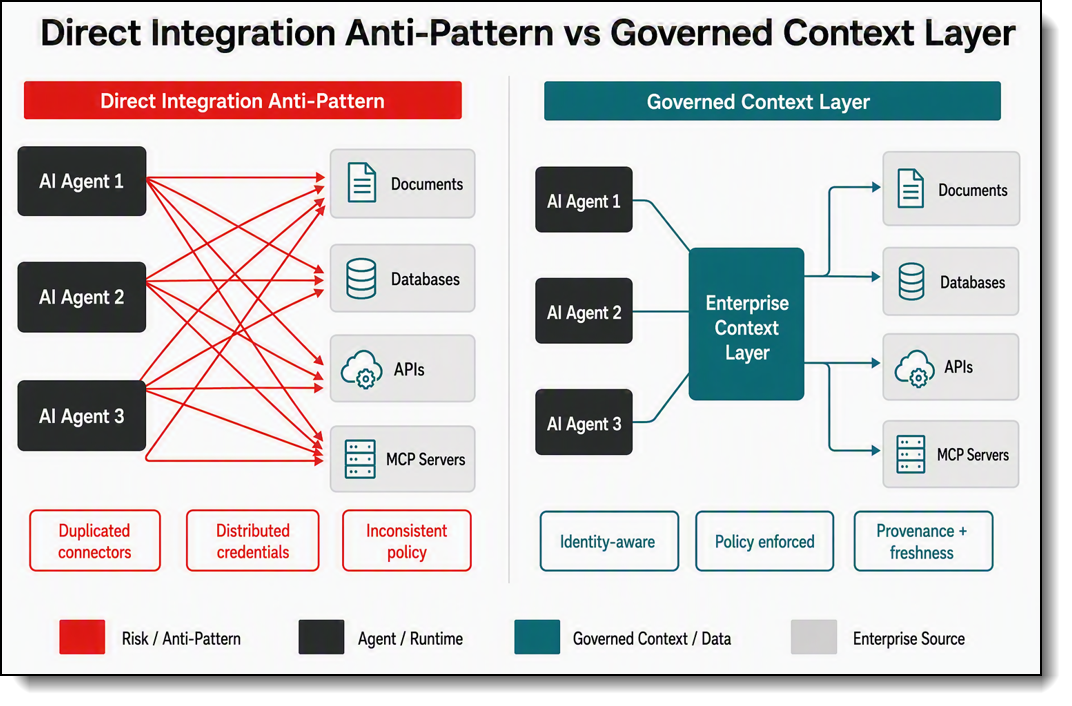
Figure 1. Direct-Connection Anti-Pattern vs Governed Context Layer
Why RAG and MCP Are Necessary but Not Sufficient
RAG and MCP each solve important parts of the context problem, but neither by itself supplies the complete set of enterprise governance, identity, freshness, and operational controls described here.
Retrieval-augmented generation is useful for discovering unstructured knowledge such as policies and runbooks. Operational agents also require structured, current state from systems such as asset repositories, lease databases, workflow platforms, and monitoring systems. A complete answer may require both document retrieval and live source queries.
MCP provides a standardized protocol for context exchange among hosts, clients, and servers. Official MCP documentation states that the protocol focuses on context exchange and does not dictate how applications use models or manage the context they receive. The Context Layer uses MCP where appropriate, while adding source governance, identity continuity, retrieval strategy, policy, provenance, freshness, tenancy, and observability.
- For details on Model Context Protocol, “Architecture overview,” documentation, see:
https://modelcontextprotocol.io/docs/2026-07-28/learn/architecture
Solution Overview
The solution separates agent reasoning, governed execution, context mediation, authoritative sources, inference, and controlled actions. The following principles, architecture view, and request flows show how those responsibilities work together.
Note, that the following is a working definition used throughout this publication.
Definition: The Enterprise Context Layer provides AI agents with a consistent, governed interface to authorized enterprise information while preserving source-system ownership and access controls. It retrieves and composes task-relevant context, applies enterprise policy, and returns the result with provenance, freshness, limitations, and permitted next actions.
In this section we cover the following topics:
Architectural Principles
The design principles in the following table translate the governing intent of the Enterprise Context Layer into practical architectural implications. Lists in this table link each architectural principle to its design implication.
High-Level Reference Architecture
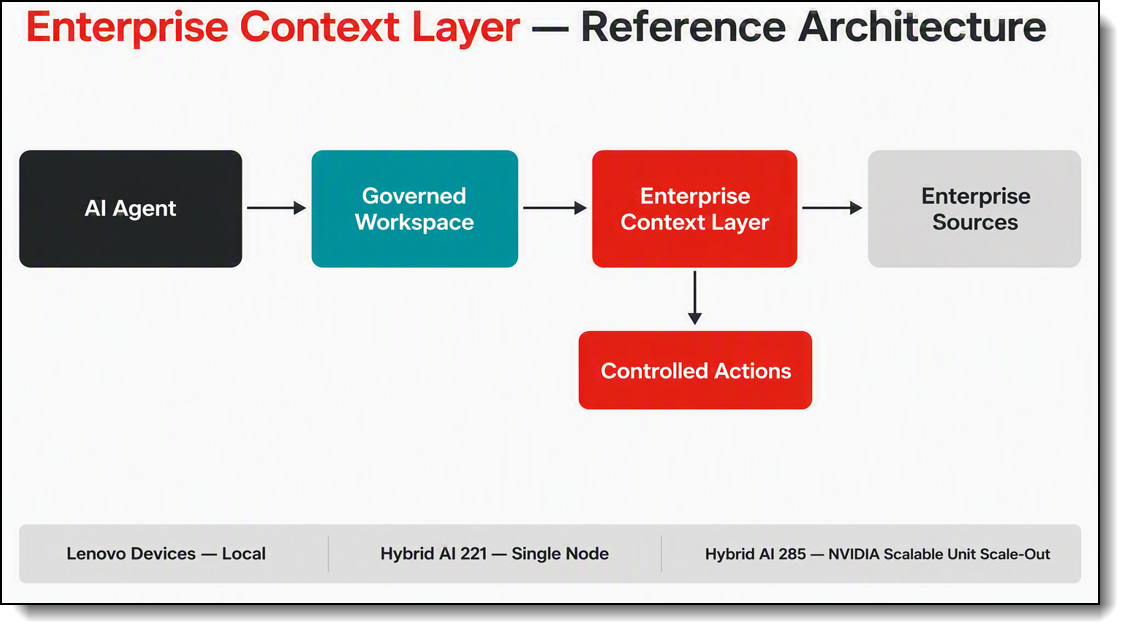
The following figure presents the major logical layers and shows the Enterprise Context Layer positioned between the governed agent workspace and authoritative enterprise sources.
AI agents use a governed workspace and a shared Enterprise Context Layer to reach authorized sources and controlled action services.
Request and Data Flows
The following figure separates the read path from the action path. This distinction allows context retrieval and state-changing operations to use different authority, approval, and evidence controls.
The read path returns minimized, source-backed context; the action path applies separate control checks.
Architecture Components
The architecture is organized as the following responsibilities. Each bullet describes a distinct boundary that can evolve independently while participating in the same governed context flow.
- Agent Runtime: Receives the user request, maintains the interaction loop, calls the configured model, exposes approved tool descriptions, executes selected tool calls, and returns the response.
- Governed Agent Workspace: Provides the execution and policy boundary for the agent, including sandboxing, network restrictions, file and process controls, and lifecycle management.
- Enterprise Context Layer Services: Provide the gateway, source registry, identity and scope mediation, retrieval and federation, semantic interpretation, policy filtering, provenance, freshness, scoped caching, and observability.
- Enterprise Sources: Remain authoritative for their own information, permissions, schema, quality, and transaction semantics.
- Shared Inference: Provides approved model endpoints independently from enterprise context services. The placement may be local, centralized, or hybrid.
- Controlled Action Services: Expose narrow, typed operations for state-changing work. They independently verify authorization, preconditions, approval, idempotency, and transaction evidence.
Lenovo Infrastructure: Lenovo infrastructure provides deployment choices for the Enterprise Context Layer, agent runtime, inference, storage, networking, and operational services.
- Lenovo Devices support local or workstation-based agent deployments.
- Lenovo Hybrid AI 221 is the primary single-node hardware deployment pattern for compact, inference-focused implementations.
- Lenovo Hybrid AI 285 is the scale-out hardware deployment pattern built around NVIDIA Scalable Units, providing repeatable multi-node compute, networking, storage, and platform expansion.
The logical Enterprise Context Layer remains consistent across these patterns; only the infrastructure scale, resiliency, capacity, and operating model change.
- Context Request and Response Contract
The following table identifies the information that should accompany a context request.
The following table identifies the evidence and controls that should accompany a context response.
Security and Governance Design
This section applies deterministic controls around identity, credentials, tools, data, tenants, and actions.
The Context Layer sits between probabilistic reasoning and high-value enterprise systems. Controls must therefore remain deterministic and external to the model wherever authority, credentials, network access, sensitive information, tenant isolation, or state-changing actions are involved.
Threat Model and Trust Boundaries
The following figure shows the trust boundaries and layered controls that must remain external to probabilistic model reasoning.
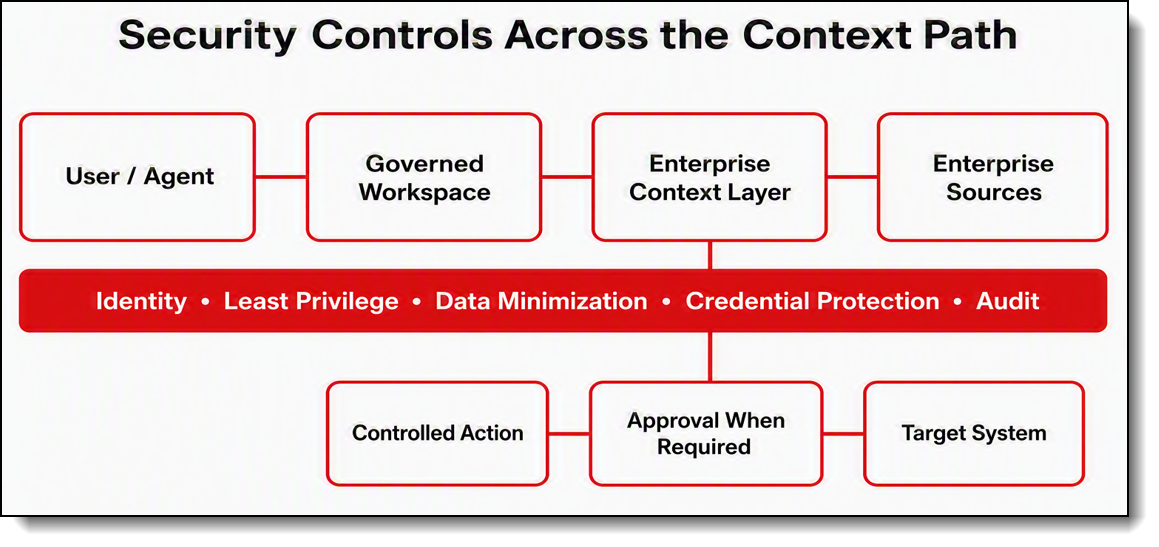
Figure 4. Layered controls around the enterprise context path
The following supporting table shows the representative threats mapping to their exposure and required control.
Identity and Delegated Authority
Identity and delegated authority should remain explicit throughout the request path so that every decision can be attributed to the correct user, agent, service, tenant, and purpose.
- Keep the user or sponsor, workspace, logical agent, service, connector, and source identities distinct.
- Carry task purpose and tenant explicitly.
- Bind delegated resources, tools, duration, approval mode, and revocation to the request or engagement.
- Revalidate authorization at the Context Layer and at each authoritative source or action service.
- Do not allow the agent to expand its own scope, tool set, or policy.
Credential Mediation
Credential mediation keeps secrets outside the agent and model context while providing only the scoped, revocable access required for an approved task.
- Keep backend and model credentials out of prompts, model context, agent memory, and user-visible errors.
- Use a secret manager or credential proxy rather than persistent secrets inside the agent environment.
- Do not turn the Context Layer into an unrestricted shared service credential.
- Rotate credentials and validate revocation during long-running workflows.
Network, Tool, and Data Controls
Network, tool, and data controls limit the agent to approved endpoints, capabilities, and information, preventing bypass of governed mediation and minimizing exposure.
- Apply default-deny egress at workspace and runtime boundaries.
- Allow only approved context, inference, telemetry, and lifecycle endpoints.
- Prevent direct bypass to enterprise systems when governed mediation is required.
- Filter tool discovery and expose only the smallest useful surface.
- Apply record and field minimization before returning context.
Tenant Isolation
Tenant isolation prevents context, credentials, cache entries, traces, and recovery data from crossing identity or organizational boundaries.
- Scope query results, caches, embeddings, indexes, credentials, logs, and memory to the correct identity boundary.
- Include tenant, identity, source, policy, and purpose in scoped cache decisions.
- Test cross-tenant retrieval, cache confusion, trace visibility, credential separation, backup, and restoration.
Prompt-Injection Controls
Prompt-injection controls treat retrieved content and tool output as untrusted data, ensuring that model-visible instructions cannot override deterministic authorization, policy, or approval boundaries.
- Treat all retrieved content and tool output as untrusted data.
- Prevent retrieved content from redefining system instructions, tool permissions, or approval rules.
- Validate model-generated tool arguments before connector or action execution.
- Use deterministic policy, egress, and approval controls outside the model.
Action Governance
The following table distinguishes action classes and the controls expected for each class.
Audit, Revocation, and Risk Management
Audit should correlate the user request, agent identity, policy evaluation, source access, transformations, context returned, model response, approval, action, and final outcome. Revocation must apply to users, agents, workspaces, connectors, policies, and credentials.
NIST describes its AI Risk Management Framework as a voluntary resource to help organizations incorporate trustworthiness considerations into the design, development, use, and evaluation of AI systems; the Generative AI Profile is a companion resource for generative AI.
- For details on NIST, “Artificial Intelligence Risk Management Framework: Generative Artificial Intelligence Profile,” NIST AI 600-1, see:
https://www.nist.gov/publications/artificial-intelligence-risk-management-framework-generative-artificial-intelligence
Deployment Architecture
The Enterprise Context Layer can run locally on Lenovo Devices, as a compact single-node deployment on Lenovo Hybrid AI 221, or as a scale-out deployment on Lenovo Hybrid AI 285 using NVIDIA Scalable Units.
The following figure introduces three Lenovo Deployment Patterns. The subsections that follow explain when local, shared, enterprise, and hybrid placement models are appropriate.
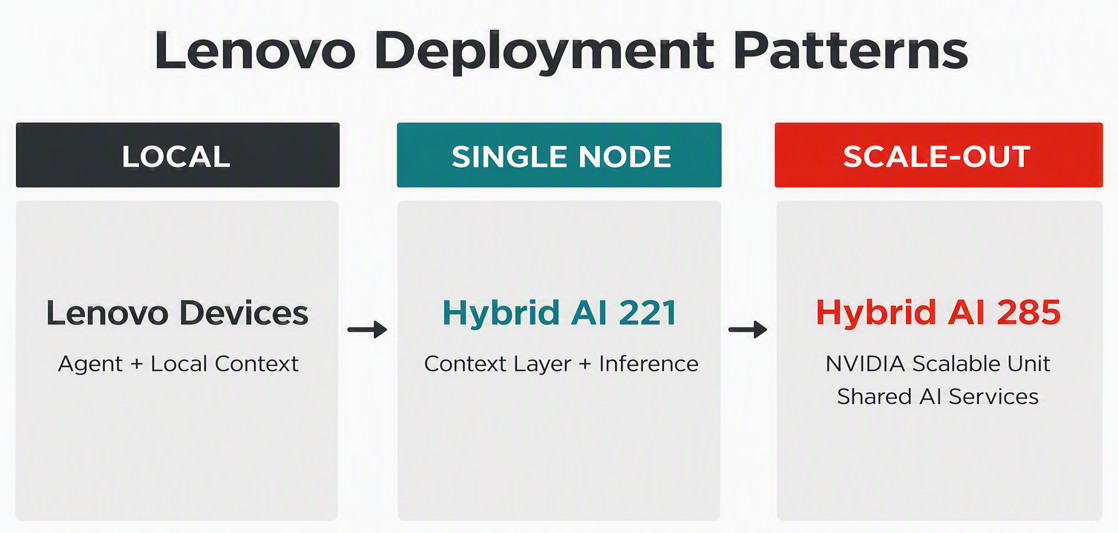
Figure 5. Lenovo Deployment Patterns
Topics in this section:
Local or Workstation Deployment
A bounded proof point can co-locate one governed workspace, a local context service, and local or approved remote inference on workstation-class infrastructure. This pattern is appropriate for controlled evaluation, domain validation, and privacy-sensitive local processing, but it requires disciplined local lifecycle and policy management.
Departmental and Enterprise Deployment
Shared deployments centralize source registration, policy, observability, and operating ownership while preserving identity, tenant, credential, cache, and result isolation. They require resilient services, capacity management, and clearly defined administrative boundaries.
Hybrid Deployment
Agent execution can remain local while inference, context, data, or lifecycle services run centrally. Placement decisions should consider data locality, latency, source connectivity, security boundaries, resilience, and operating responsibility.
Placement and Scaling Considerations
Placement and scaling decisions should balance workload demand, source characteristics, context freshness, isolation, resilience, and operational constraints.
- Number of workspaces and concurrent context requests
- Source latency and consistency requirements
- Context size, query cost, and freshness expectations
- Cache scope and isolation •Inference placement and capacity
- High availability, backup, recovery, and change windows
- Tenant trust model and compliance requirements
Implementation Example and Validation
This section maps the reference pattern to a Lab Operations Agent example and distinguishes architectural illustration from approved validation evidence. The implementation example uses the Lab Operations Agent because it requires current state from multiple operational systems and has a natural distinction between read context and state-changing actions. Internal architecture artifacts describe Hermes skill modules using Spice.ai for the read surface and infrastructure-specific MCP servers for write operations.
Topics in this section:
Lab Operations Agent
The Lab Operations Agent demonstrates how governed read access and separately controlled actions can be combined in an operational workflow. Figure 6 presents the logical paths and the accompanying detailed architecture.
The Lab Operations Agent is a governed AI operations assistant designed to manage the end-to-end lifecycle of shared lab infrastructure. It provides a conversational interface through Microsoft Teams while coordinating deterministic workflows for asset discovery, request intake, approval, reservation, provisioning, lease monitoring, health monitoring, extension review, reclamation, and audit reporting.
The agent is intended to reduce the manual effort and elapsed time required to allocate and manage lab resources without removing operational control from administrators. Users can describe workload and capacity requirements in natural language. The agent then retrieves current asset, request, lease, workflow, and health information; evaluates the request against defined rules; and guides it through the appropriate approval and fulfilment process.
The implementation separates reasoning from authority:
- Hermes manages agent reasoning, planning, skills, and tool selection.
- NemoClaw and OpenShell provide the governed execution boundary.
- Spice.ai provides the controlled context and data-access path.
- NetBox supplies infrastructure inventory and allocation state.
- Monday.com supports request tracking and human approval.
- PostgreSQL and RabbitMQ maintain operational state and event-driven processing.
- Infrastructure-specific MCP services execute approved reservation, provisioning, monitoring, and reclamation operations.
- Human reviewers retain authority for actions that require administrative or risk-based approval.
LabOps is used in this paper as a practical validation of the Enterprise Context Layer pattern because it requires both current multi-source context and tightly controlled state-changing actions. It demonstrates how an agent can understand operational state through a governed read path while using separate action services for execution.
The following image is a high level flow of LabOps.
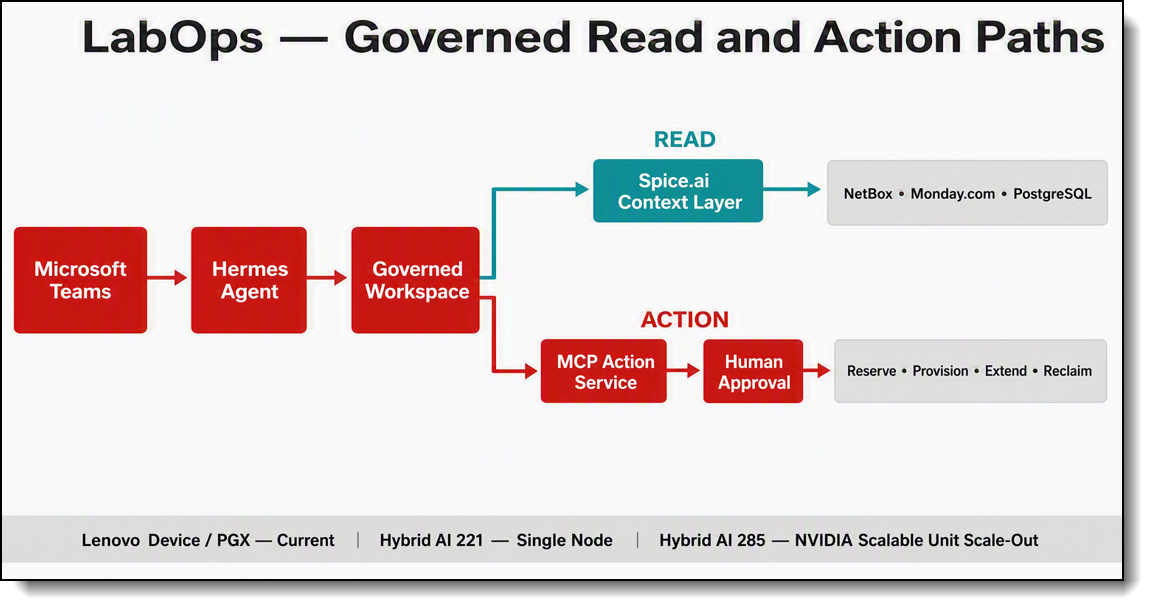
Figure 6. High level flow of LabOps
The following image is a representation on how LabOps applies the Enterprise Context Layer pattern by separating governed information access from approved infrastructure actions and by supporting progression from local hardware to single-node and scale-out deployment patterns.
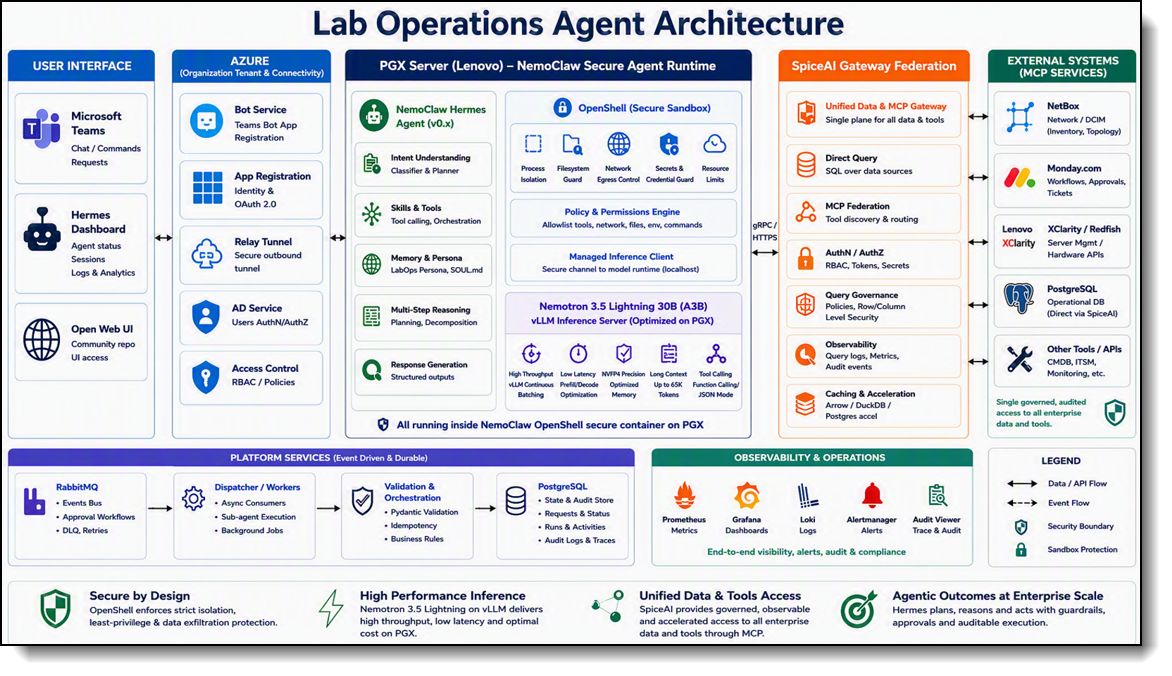
Figure 7. LabOps applying the Enterprise Context Layer pattern
Stateless Event-Driven Architecture
The following diagram represents a multi-agent, event-driven architecture for IT asset and service operations, where Microsoft Teams acts as the user interaction channel and communicates through a Bot Adapter with the central Hermes Agent, which orchestrates user requests by separating them into synchronous and asynchronous execution paths.
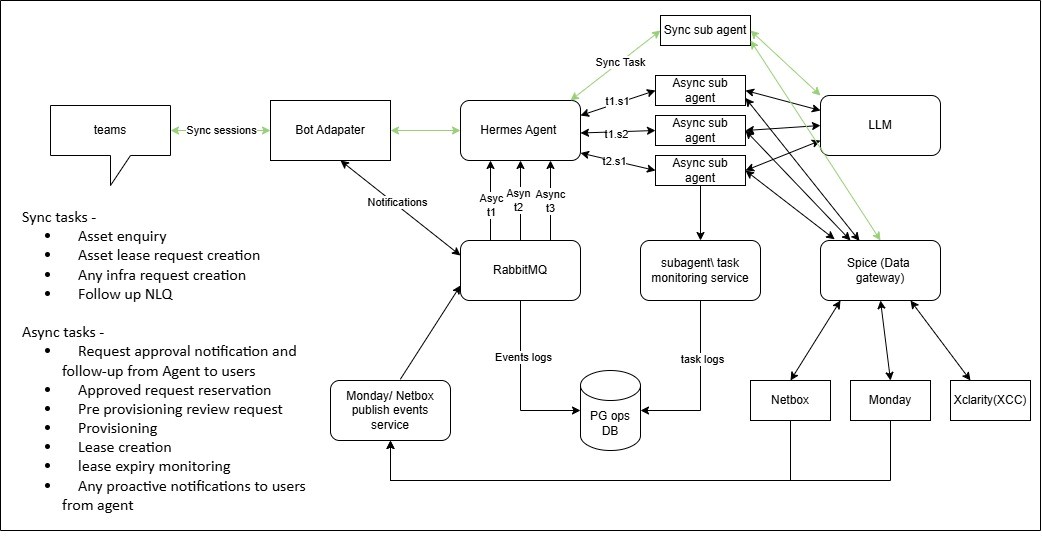
Figure 8. LabOps applying the Enterprise Context Layer pattern
Synchronous requests, such as asset inquiries, asset lease creation, infrastructure request creation, and follow-up natural-language queries, are routed directly to a Sync Sub-Agent for immediate processing, while longer-running workflows, including approval notifications, approved-request reservation, pre-provisioning reviews, provisioning, lease creation, lease-expiry monitoring, and proactive notifications, are delegated through RabbitMQ to multiple Async Sub-Agents (t1.s1, t1.s2, t2.s1, etc.), enabling decoupled and scalable background processing. The sub-agents interact with an LLM for language/reasoning capabilities and access enterprise operational systems through Spice (Data Gateway), which provides connectivity to NetBox, Monday, and XClarity (XCC).
A dedicated sub-agent task monitoring service captures execution/task logs, while RabbitMQ event logs and task-monitoring data has persisted in the PG Ops DB for operational tracking. Monday/NetBox publisher event services publish infrastructure and workflow events into RabbitMQ, allowing asynchronous processing and proactive agent-driven notifications, which are sent back through the Bot Adapter to Teams. Overall, the architecture combines agent orchestration, LLM-driven processing, message-queue-based asynchronous execution, centralized data integration, task observability, and event-driven automation to support scalable infrastructure and asset lifecycle operations.
Source Systems and Context Flows
The following table maps common LabOps needs to required context and illustrative sources.
Read Context Path
For the Read Context Path, the following steps need to be followed:
- The user asks a LabOps question through an approved channel.
- Hermes calls the configured model and exposes approved context tools.
- The model selects a tool; Hermes executes the MCP call.
- OpenShell permits the approved context endpoint.
- The context service retrieves authorized source data and composes the domain result.
- The model receives minimized context with source, freshness, limitations, and permitted next action.
Controlled Action Path
For the Controlled Action Path, the following steps need to be followed:
- The agent retrieves current state and action prerequisites.
- The agent proposes a typed action rather than using broad backend access.
- The action service independently checks identity, parameters, risk, policy, preconditions, and approval.
- A human review gate is applied where required.
- The service executes with narrow authority and returns transaction evidence.
Design Considerations and Recommendations
The recommendations in this section help architecture teams decide when the pattern is warranted and how it differs from adjacent integration and retrieval approaches.
Topics in this section:
When to Use the Pattern
Use the Enterprise Context Layer when context access, policy, evidence, and operational controls must be shared or consistently governed across sources, agents, or actions.
- An agent needs context from more than one enterprise source.
- Multiple agents will reuse the same sources, semantics, or policy.
- The context contains sensitive or tenant-scoped information.
- The answer requires current structured state as well as documents.
- Actions require approval, preconditions, or transaction evidence.
- The organization needs consistent provenance and operating ownership.
Context Layer versus MCP Gateway
An MCP gateway governs connectivity, discovery, routing, and often authentication or authorization for MCP servers. The Context Layer includes the broader enterprise responsibility for source governance, identity continuity, retrieval and composition, semantics, policy, freshness, provenance, tenancy, and operations.
Build versus Integrate
The logical pattern should remain vendor-neutral. Products can implement several responsibilities, but no component should be assumed to provide the complete architecture. Spice.ai documents MCP federation and the combination of MCP tool output with federated SQL and vector search; this makes it relevant to the implementation example, while a dedicated MCP gateway or enterprise identity service may still own capabilities outside its validated scope.
- For details on Spice.ai, “Federated MCP Client for Distributed Tool Ecosystems” and “MCP Server and Gateway for Enterprise AI Agents.”, see:
https://spiceai.org/docs/use-cases/ai/federated-mcp-server
Operations and Lifecycle
Operational ownership is required to keep policies, connectors, credentials, caches, and recovery processes current throughout the service lifecycle.
Topics in this section:
Monitoring and Observability
Monitoring and observability should provide end-to-end visibility into context requests, source access, policy decisions, performance, freshness, costs, and action outcomes.
- Request and trace identifiers
- Identity and tenant attribution
- Source and connector health
- Policy permits and denials
- Retrieval latency, context volume, and freshness
- Cache activity and invalidation
- Tool and action results
- Model and context-service cost attribution
Policy and Connector Lifecycle
Source and tool registration should include ownership, schema, classification, version, endpoints, intended use, health, and retirement status. Connector and policy changes should be reviewed, tested, versioned, and rolled back independently from agent prompts and skills.
Backup, Recovery, and Retention
The operating model should define which context-service state is durable, what is cached, how retention and deletion are enforced, how tenant-scoped state is backed up and restored, and how source-of-truth systems are reconciled following recovery.
Ownership and Operating Model
The following table assigns accountability across the operating model.
Summary
This section consolidates the architectural rationale, separation of responsibilities, and practical value of the Enterprise Context Layer.
Enterprise agents require more than access to models and tools. They need context that is authorized, task-relevant, semantically meaningful, current, and traceable. Connecting every agent directly to every enterprise source transfers integration and security complexity into the least deterministic part of the system.
The Enterprise Context Layer creates a stable mediation boundary. It allows agent frameworks and enterprise systems to evolve independently while preserving identity, source authority, policy, provenance, and operational control. It also creates a deliberate distinction between understanding enterprise state and changing that state.
The Lab Operations Agent illustrates the pattern. Hermes and the model provide agent-side reasoning and tool selection. NemoClaw and OpenShell provide the governed execution boundary. Spice.ai implements selected context and federation capabilities. Source systems remain authoritative. Narrow action services execute approved changes. Together, these responsibilities form a reusable architecture without claiming that one product provides the complete solution.
Final takeaway: A context-aware agent is not simply an agent with more data. It is an agent that receives the minimum authorized enterprise context required for the task, with meaning, freshness, provenance, limitations, and controlled next actions.
Appendix A. Security Control Matrix
The following table maps security controls to enforcement locations and evidence.
Appendix B. Validation Checklist
The following Validation Checklist applies as follows:
- Attempt cross-tenant query, cache, index, log, and credential access.
- Attempt direct egress to an unapproved source.
- Attempt a write through the read surface.
- Change source state, expire cache, and disable a required source.
- Embed malicious instructions in a retrieved document or tool output.
- Inspect prompts, memory, files, environment, logs, and outbound calls for secrets.
- Retrieve and compose authorized context from at least two sources.
- Rotate credentials, update policy, remove a connector, and revoke an active agent.
- Run the same request under allowed and denied identities.
- Trace a response and an action to source, policy, approval, and transaction evidence.
Appendix C. Terminology and Acronyms
The following table defines the principal terms used in this publication.
References
For more information, see these resources:
- Model Context Protocol, “Architecture overview,” documentation:
https://modelcontextprotocol.io/docs/2026-07-28/learn/architecture - NVIDIA, “Secure Agent Workspace Reference Design: Reference Architecture”
https://docs.nvidia.com/enterprise-reference-architectures/secure-agent-workspace-reference-design/latest/reference-architecture.html - Spice.ai, “Federated MCP Client for Distributed Tool Ecosystems” and “MCP Server and Gateway for Enterprise AI Agents
https://spiceai.org/docs/use-cases/ai/federated-mcp-server - NIST, “Artificial Intelligence Risk Management Framework: Generative Artificial Intelligence Profile”
https://www.nist.gov/publications/artificial-intelligence-risk-management-framework-generative-artificial-intelligence - OWASP, “AI Agent Security Cheat Sheet.”
https://cheatsheetseries.owasp.org/cheatsheets/AI_Agent_Security_Cheat_Sheet.html - Lenovo Press, “Lenovo Hybrid AI 285 Platform Guide”
https://lenovopress.lenovo.com/lp2181-lenovo-hybrid-ai-285 - SKU Part Numbers:
- ISG Nemoclaw in box - 5MS7C42207
- IDG Early Preview Nemoclaw in box - 5MS1X14123
Authors
Drew Johnson is the project manager in the SSG AI team. Focusing on the project deliverables and milestones and co-ordination of different streams.
Dinesh Tripathi is a technical lead in the SSG AI team. Focuses on the technical direction and implementation of enterprise AI architectures and agent solutions.
Firoz Rangwala is Director of Architecture in the SSG AI team. Provides architectural leadership for enterprise AI initiatives and the design of governed, scalable AI solutions.
Harry Svendsgaard is a hybrid cloud lab engineer in the SSG AI team. Core developer and AI data engineer.
Harshad Vidyadhar Tatwadi is an Enterprise Architect in the SSG AI team. Develops enterprise architecture patterns that connect AI agents, governed context, infrastructure, and operational workflows.
Rishabh Sachan is a Cloud Architect in the SSG AI team. Contributes cloud architecture guidance for enterprise AI platforms, integrations, and deployment patterns and automation.
Surbhi Taneja is a Product Manager in the SSG AI team. Helps align enterprise AI capabilities and solution requirements with product priorities and customer needs.
Tabor Scott is the Cyber Security Architect in ths SSG AI team. Driving AI security, guardrail, governance at the whole within all SSG projects.
Trademarks
Lenovo and the Lenovo logo are trademarks or registered trademarks of Lenovo in the United States, other countries, or both. A current list of Lenovo trademarks is available on the Web at https://www.lenovo.com/us/en/legal/copytrade/.
The following terms are trademarks of Lenovo in the United States, other countries, or both:
Lenovo®
XClarity®
The following terms are trademarks of other companies:
Microsoft® and Microsoft Teams® are trademarks of Microsoft Corporation in the United States, other countries, or both.
NVIDIA® is a trademark of NVIDIA Corporation.
Other company, product, or service names may be trademarks or service marks of others.
Configure and Buy
Please select a locale
Full Change History
Course Detail
Employees Only Content
The content in this document with a is only visible to employees who are logged in. Logon using your Lenovo ITcode and password via Lenovo single-signon (SSO).
The author of the document has determined that this content is classified as Lenovo Internal and should not be normally be made available to people who are not employees or contractors. This includes partners, customers, and competitors. The reasons may vary and you should reach out to the authors of the document for clarification, if needed. Be cautious about sharing this content with others as it may contain sensitive information.
Any visitor to the Lenovo Press web site who is not logged on will not be able to see this employee-only content. This content is excluded from search engine indexes and will not appear in any search results.
For all users, including logged-in employees, this employee-only content does not appear in the PDF version of this document.
This functionality is cookie based. The web site will normally remember your login state between browser sessions, however, if you clear cookies at the end of a session or work in an Incognito/Private browser window, then you will need to log in each time.
If you have any questions about this feature of the Lenovo Press web, please email David Watts at dwatts@lenovo.com.


